The influence of foreclosures and short sales on the housing market is minimal.
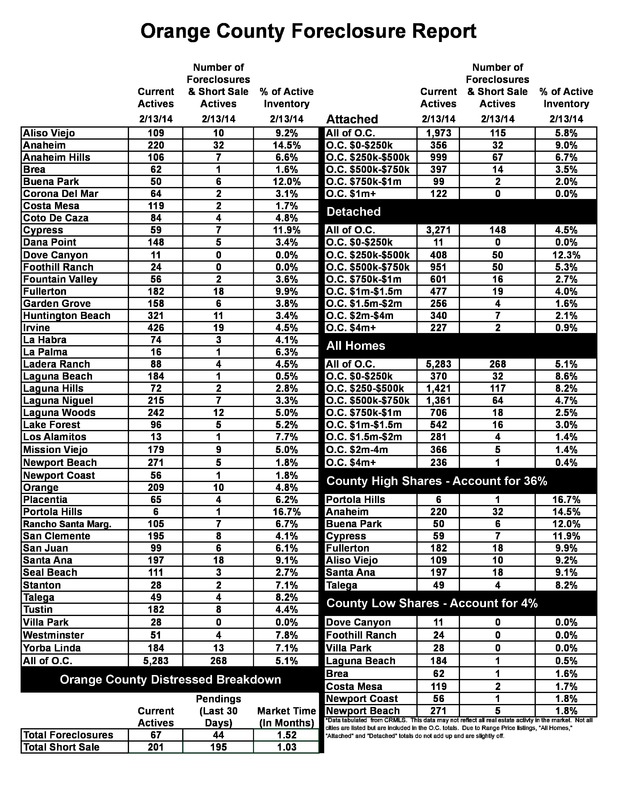
Distress: foreclosures and short sales make up only 5% of the overall inventory.
It is amazing how often people ask about foreclosures. Buyers want to buy a foreclosure. Investors want to buy foreclosures. Shadow inventory? Empty foreclosures intentionally held off the market? When’s the wave?
The reality is that as the interest in distressed homes has grown exponentially, the number of foreclosures and short sales placed on the market has dropped dramatically. Buyers and investors wishes for more distressed sales have become nothing more than wishful thinking. The more they ask, the less they find.
The number of homes placed on the market for the first six weeks of 2014 is up 4% compared to the first six weeks of 2013. That’s not a significant change. In digging deeper, the overall makeup of the inventory has changed radically. The number of foreclosures is down 70% and short sales are down 68%. Yet, the number of homeowners with equity placed on the market is up 19%. There are only 260 foreclosures and short sales that were placed onto the market thus far in 2014. Compare that to 828 in 2013 and 2,101 in 2012.
It is pretty safe to say that the change is not a fluke, but a commanding shift in the market. Here’s the earth shattering headline to take away from the data: the distressed market, both foreclosures and shorts sales, is down 69% from last year in Orange County.
The trend began a year ago. The year to year drop in comparing 2013 to 2012 was 61%. It was jaw dropping news a year ago, which illustrates just how impressive this year’s drop is in comparison. The distressed tank is running on empty and the fuel light just came on.
Does that mean that distressed homes will vanish? Not hardly. Instead, expect to deal with these low levels for some time. There are still a lot of homes at different stages of the foreclosure process, the infamous “shadow inventory.” Collectively, banks have been slow to foreclose and slow to approve short sales. That has been an intentional strategy that, on the surface, has seemed to work surprisingly well. On average, according to Foreclosure Radar, it takes about a year in Orange County for banks to foreclose. Banks are not going to change this strategy anytime soon because it has worked. Unleashing a steady, slow stream of distressed properties has helped reignite the housing market and the overall inventory has dropped substantially from earlier in the downturn.
Now that home values have recovered impressively over the course of the last couple of years, many homeowners who were upside down have been freed from the grip of owing more than their home was worth. As a result, there will be fewer short sales, fewer homeowners walking away from their homes, and, ultimately, fewer foreclosures.
Distressed Breakdown: The distressed inventory increased by 10 homes in the past two weeks.
The distressed inventory, foreclosures and short sales combined, increased by 4%, 10 homes, in the past two weeks and now totals 268. Only 5% of the active listing inventory and 10% of demand is distressed. Compare that to last year when it represented 10% of the inventory and 26% of demand, and two years ago when it represented 33% of the inventory and 56% of demand. As noted earlier, the impact of distressed homes on the overall Orange County real estate market is minimal.
In the past two weeks, the foreclosure inventory increased by 14 homes and now totals 67. 1% of the inventory is a foreclosure. The expected market time for foreclosures is 46 days. The short sale inventory decreased by 4 homes in the past two weeks and now totals 201. The expected market time is 31 days. Short sales represent just 4% of the total active inventory.
Active Inventory: The inventory increased by 4% in the past two weeks.
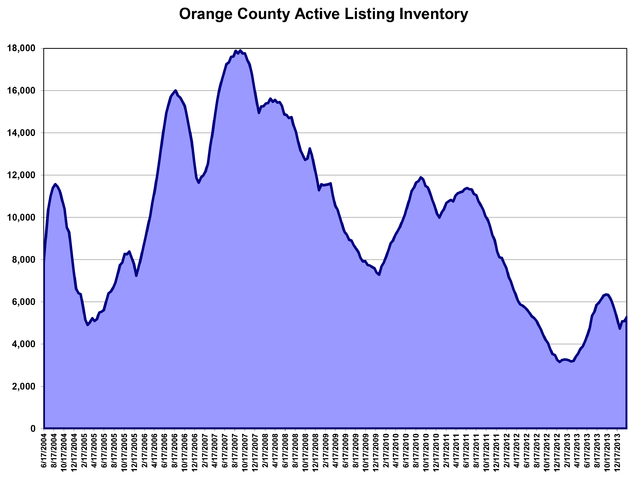
The inventory added an additional 196 homes in the past two weeks and now totals 5,283. This increase comes despite an increase in demand. Remember, the active inventory does not include pending sales; so, homes are being placed on the market while others are pulled off as they become pending sales. Currently more homes are coming on the market than are coming off. The net result is an increase in the active inventory.
With many homes coming on the market at far reaching, overpriced levels, they will not realize success until they reduce their asking price to the Fair Market Value, what buyers are willing to pay. This is based upon the most recent comparable sales. Buyers do not want to overpay, so they are approaching the market cautiously. Overpriced homes will come on the market and accumulate, causing the inventory to rise.
Last year at this time there were 3,272 homes, 2,011 fewer than today.
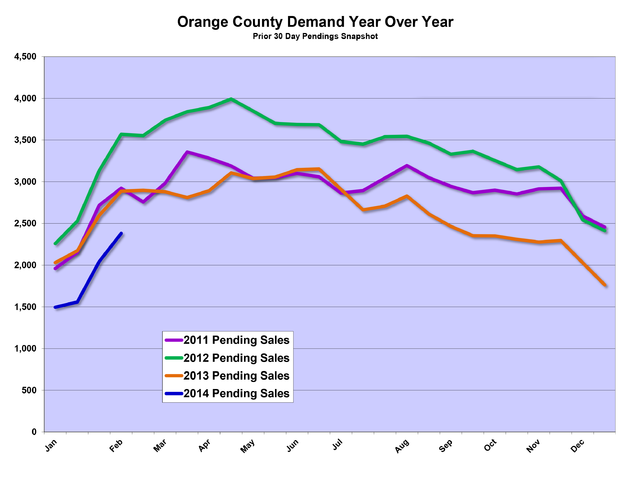
Demand: Demand increased by 17% in the past two weeks.
Demand, the number of new pending sales over the past month, increased by 338 and now totals 2,381. Demand will continue to increase and will gain momentum through the Spring Market. Last year demand was at 2,887 pending sales, 506 more than today. Demand may not at the same clip as last year, but it is gaining momentum just as it typically does after the Super Bowl.
For the sellers that price their homes at their Fair Market Values, they are finding success because demand is improving. There are buyers in the marketplace ready to buy at the right price. The expected market time for all homes in Orange County is currently at 67 days, dropping from 75 days just two weeks ago.


:format(webp):quality(80)/u.realgeeks.media/hakolas/Facebook.jpg)
:format(webp):quality(80)/u.realgeeks.media/hakolas/GooglePlus.jpg)
:format(webp):quality(80)/u.realgeeks.media/hakolas/YouTube.jpg)
:format(webp):quality(80)/u.realgeeks.media/hakolas/Twitter.jpg)
:format(webp):quality(80)/u.realgeeks.media/hakolas/Zillow.png)