The Spring Market is finally here with stronger demand and sellers who are still in the driver’s seat.
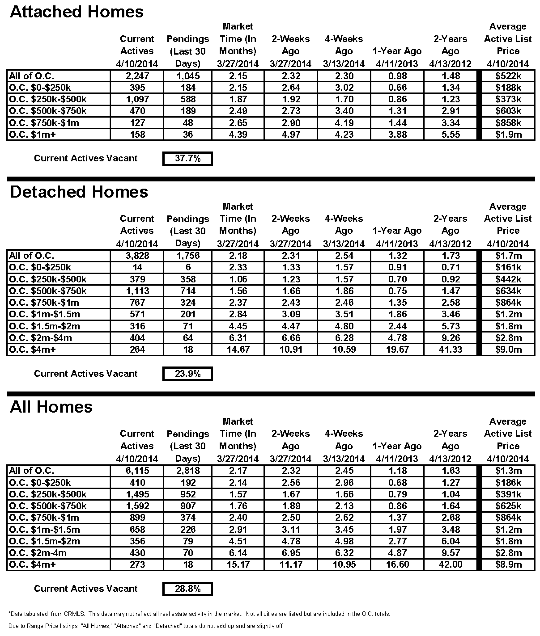
A Seller's Market: with an expected market time of 65 days, it is definitely a seller’s market.
The Orange County Spring Market arrived late this year. It’s not because of the harsh winter. It’s not because of a major change in interest rates. Instead, buyers are pulling the trigger and purchasing homes that are priced right.
Cyclically, this is the hottest time of the year in terms of pending sales activity. More buyers pull the trigger during the spring than any other time of the year. Many mistaken the Summer Market as the best time of the year to sell, but that’s just not the case. The confusion stems from reports of closed sales. There are more closed sales during the summer compared to the spring. More buyers prefer to move when the kids are out of school, over summer vacation. Depending upon the school, summer vacation runs anywhere from mid-May through August. In order to move during those months, homes are placing into escrow from now through June. Since pending sales, on average, take 45 days to close, those summertime sales are really a reflection of pending sales during the spring.
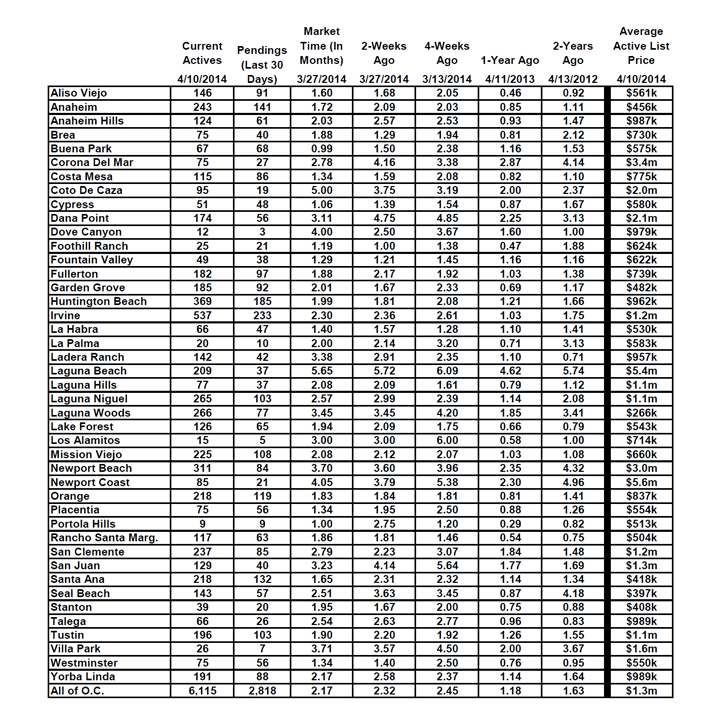
Now is the busiest time of the year for real estate. The expected market time for all of Orange County has dropped from 98 days in January to 65 days today. Anything below a five month expected market time is a seller’s market and Orange County housing is well below that threshold. Many feel the market has stalled because homes are not flying off the market like they did last year. But, for the first half of the year the market was crazy and way out of balance. The expected market time last year was at 35 days. The inventory was at an incomprehensible historical low during the spring. Home values soared and many buyers were unable to purchase due to a lack of supply.
Today’s seller’s market is a bit different because homes are not appreciating uncontrollably. Sellers are in the driver seat, enabling them to sell at a reasonable price in a reasonable amount of time. That does not mean that they are able to price a home wherever they want and they will achieve success. Last year, sellers were able to aggressively price their homes much higher than the last sale and they were still receiving multiple offers and often selling for higher than their list price. That simply is not the case today.
After a couple of years of steep appreciation, buyers no longer want to pay a lot more than the most recent closed sale. Homes that are priced too high compared to comparable sales are just sitting on the market. In order to achieve success and lure willing and able buyers, they simply will have to reduce their asking prices.
For example, if the most recent comparable sale is $500,000, a home placed on the market at $550,000 will not sell. Many sellers feel they need to leave extra “wiggle room” and will price the home at $525,000 in hopes of achieving a little bit more. Often overlooked, if the home was priced closer to $500,000, demand is much stronger right now, so the odds of entertaining multiple offers increase dramatically. As a seller, the best case scenario is to deal with multiple offers. Multiple offers squeeze the very most out of price, enabling sellers to often achieve at or over the asking price.
Buyers need to understand that they are not in the driver’s seat in today’s seller’s market. Even with an increasing inventory, the supply of homes is still well below long term averages. This is the primary reason that the expected market time is so low. There are no “incredible deals,” the distressed inventory makes up only 6% of the overall market, and sellers have the upper hand. So, paying the Fair Market Value is reasonable, but a “deal” is out of the question. If a home needs interior paint, subtracting $20,000 is not realistic. As a buyer, the winning strategy is to carefully determine price based upon comparable sales data, taking into proper consideration location and condition.
The good news for buyers, there is more inventory and the expected market time is more favorable than a year ago. But, buyers are not able to be extremely picky either. The old axiom, “you snooze, you lose” definitely applies. Many buyers are spinning their wheels with an unrealistic approach that will result in not being able to secure a home.
Active Inventory: The inventory increased by 4% in the past two weeks.
The active listing inventory added an additional 263 homes in the past two weeks and now totals 6,115, levels not seen since last November. Last year’s inventory height was reached in October and totaled 6,350. This year, the inventory has grown unabated and is poised to continue to increase through the end August. By then, the inventory may surpass the 8,000 threshold, much closer to Orange County’s long term average.
After starting the year at 4,733, the inventory has climbed 1,382 additional homes, a 29% increase. Keep in mind, in order for the active inventory to grow, more home need to be placed on the market than are coming off as pending sales. Overpricing is not helping matters either, because they sit on the market until the seller reduces the asking price closer to the Fair Market Value where buyers are willing to pay.
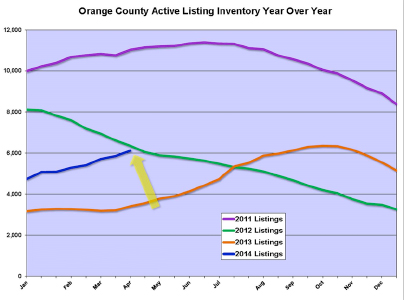
Last year at this time there were 3,407 homes on the market, 2,708 fewer than today. The inventory has risen 79% since last year.
Demand: Demand increased by 12% in the past two weeks and 21% in the past month.
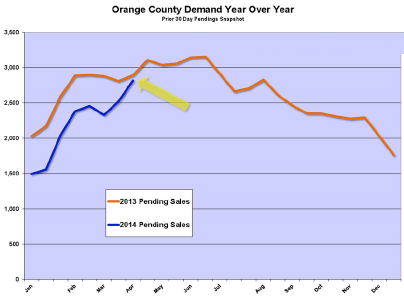
Demand, the number of new pending sales over the past month, increased by 296 and now totals 2,818. As we roll further into the Spring Market, cyclically the hottest time of the year for housing, demand will remain elevated. It will most likely reach a height for the year by the end of this month. Last year demand was at 2,893 pending sales, just 75 more than today. The gap between last year’s demand and this year’s is narrowing considerably.
Distressed BreakdownThe distressed inventory decreased by 2% in the past two weeks.
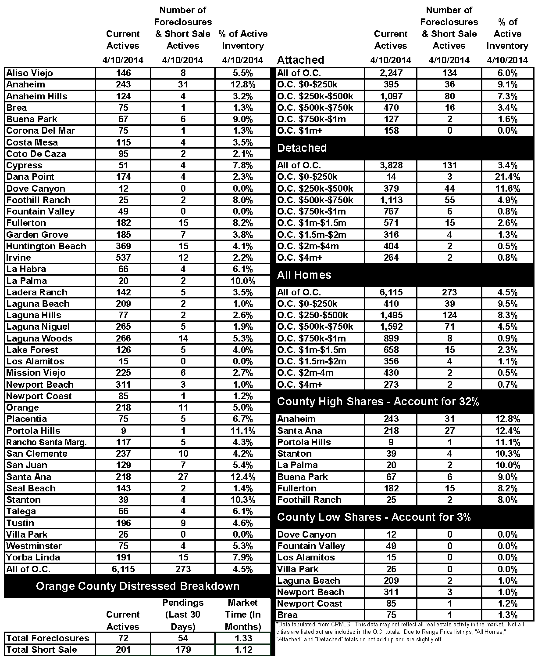
The distressed inventory, foreclosures and short sales combined, decreased by 6 homes and now totals 273. The distressed inventory remains at a very low level. Only 4% of the active listing inventory and 8% of demand is distressed. Compare that to last year when it represented 6% of the inventory and 18% of demand, and two years ago when it represented 25% of the inventory and 49% of demand.
Distressed properties have an insignificant effect on the overall housing market because their numbers have dwindled considerably. In March, only 1% of all closed sales were foreclosures and 5% were short sales. That means that 94% of the market consisted of good ol’ fashioned sellers with equity in their homes.
In the past two weeks, the foreclosure dropped by 11 homes and now totals 72. There are 144 zip codes in Orange County, so there simply are not enough foreclosures to go around. 1% of the inventory is a foreclosure. The expected market time for foreclosures is only 40 days. The short sale inventory increased by 5 homes in the past two weeks and now totals 201. The expected market time is 34 days and is the hottest segment of the housing market. Short sales represent just 3% of the total active inventory.
:format(webp):quality(80)/u.realgeeks.media/hakolas/Facebook.jpg)
:format(webp):quality(80)/u.realgeeks.media/hakolas/GooglePlus.jpg)
:format(webp):quality(80)/u.realgeeks.media/hakolas/YouTube.jpg)
:format(webp):quality(80)/u.realgeeks.media/hakolas/Twitter.jpg)
:format(webp):quality(80)/u.realgeeks.media/hakolas/Zillow.png)