Many buyers tire from too much competition and opt to wait, but
it has proved to be the wrong decision.
Waiting to Buy: Buyers who have opted to wait a year ago are looking at monthly payment increase of 25% for the median priced detached home today.
For buyers, the Orange County real estate market has been extremely tough for the past 18-months. With very little supply, tremendous competition, multiple offers, offers over the asking price, and brisk appreciation, many buyers decided to retreat to the sidelines and wait until the market was a bit less crazy.
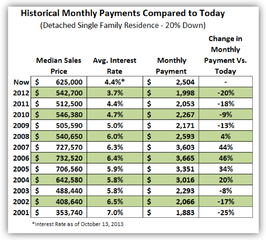
The good news: after a year-and-a-half, the market is a little less crazy right now. The bad news: with higher interest rates and massive appreciation, the payment for the median priced home skyrocketed by 33%. The monthly payment for the median priced detached home in 2012, $542,700, along with the average interest rate of 3.7%, was $1,998. According to Dataquick, the median price of a detached home is currently at $625,000, a 21% increase year over year. Given today’s interest rate of 4.4%, the monthly payment for the current Orange County median is $2,504, a $506 increase.
So, for last year’s buyer who was understandably frustrated and opted to sit the market out after writing offer after offer to no avail, they are now looking at a monthly payment that went up by $506 per month. That’s a little over $6,000 extra per year, each and every year, or $30,000 in five years.
To be fair, even if every buyer decided they were going to stick to their guns and purchase no matter how many offers they had to write, there just wasn’t enough inventory to match the unbelievable demand. Buyers would have still been unsuccessful in their attempts to purchase given the supply constraints.
In comparing today’s median sales price payment to prior years, the payment is not as high as 2004 through 2008. It is slightly higher than the annual median in 2003. Last year’s median payment was the lowest since 2001. With appreciation and higher interest rates, home affordability has been on the decline.
These facts are irritating for the buyer who has wanted to buy, but simply was not able to compete. The problem was that prices were just too low coupled with interest rates that were artificially too low. Now, prices have bounced back and are at a more realistic level and interest rates are on the rise.
There is good news. The market is less crazy right now. Homes are not flying off the market. Where homes had generated a baker’s dozen of offers, they are now looking at two or three at best. Many homes are sitting and not generating any offers at all. Ultimately, it is now all about price. Today, buyers have choices. It is still a seller’s market, just not as strong. Appreciation has slowed significantly and the month to month run-up in prices has come to a complete halt.
The best advice for a buyer is to not look longingly in the rearview mirror at what their payments could have been if they were successful a year ago. Instead, knowing that interest rates are going to rise, purchasing right now is the best strategy. The California Association of REALTORS® just delivered their annual forecast for the coming year, and they expect interest rates to rise to 5.3%. It is understandable that we have all got used to these wonderful, historically low interest rates, but we need to keep in mind that the Federal Reserve has been pumping money into the system; basically, printing money. The Fed can only do this for so long. Over time, inflationary pressure will build, and the Fed fights inflation by increasing interest rates.
Back in June, the Federal Reserve announced that they were going to start to “taper” pumping money into the secondary market. They were warning everybody that they could not print money forever and wanted to start to cut back their involvement and eventually would pull out altogether. Wall Street responded with a big drop and interest rates shot up by 1% seemingly overnight. For now, the Fed has place tapering on hold, but expect it to start at the beginning of 2014. As they taper, interest rates will rise.
Appreciation for next year is forecasted to be a modest 6%, which would be an increase in the detached median to $656,250. The payment, based upon the 5.3% interest rate forecast, would be $2,915, an increase of $411 per month every single month, or $4,932 per year. Even if homes did not appreciate one dime, but interest rates still popped up to 5.3%, the monthly payment would be $2,778, an increase of $274 per month. For the average person, $411 or $274 per month is a lot of money and they would prefer utilizing it as disposable income.
In looking at the data, it did not pay for a buyer to sit out the market over the past year. We will be coming to the same conclusion a year from now: it will not pay to wait to purchase.
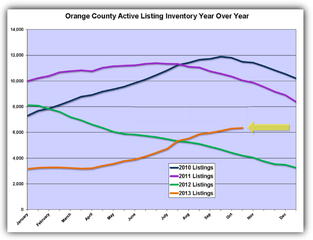
Active Inventory: The inventory increased by only 1% in the past two weeks.
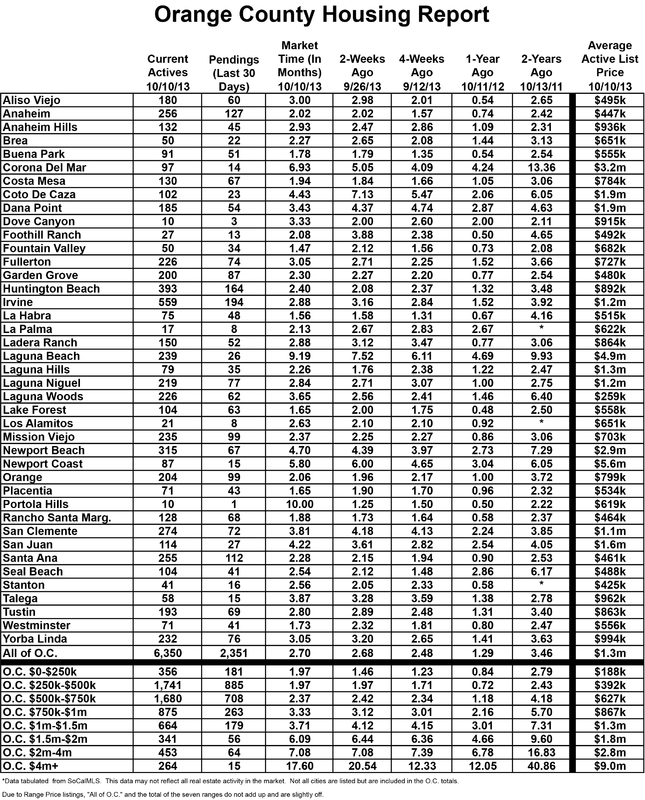
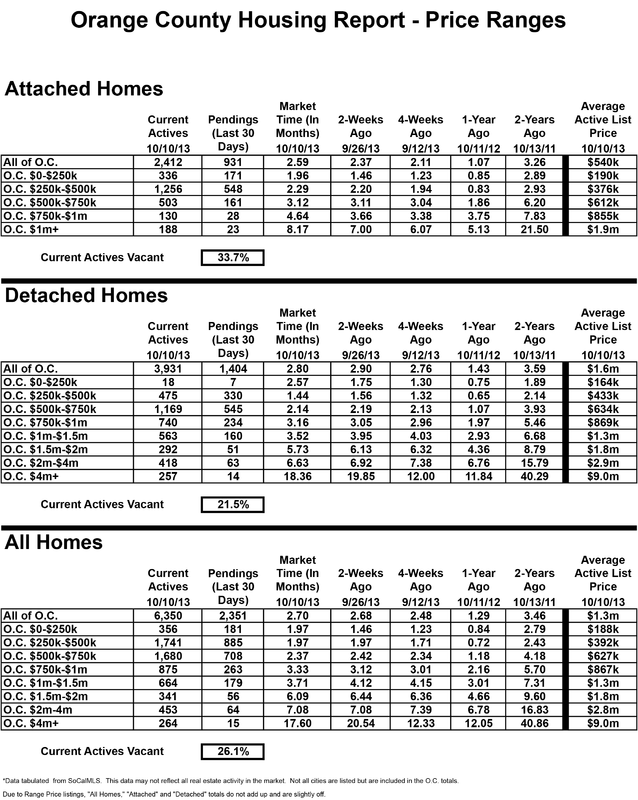
In the past two weeks, the active listing inventory added only 52 homes, or 1%, and now totals 6,350, levels last posted in April 2012. We are officially in territory not seen since 2005, where the inventory continued to increase well beyond the normal yearly inventory peak, the end of August. But in 2005, the increase was going strong during this time of the year, rising at a rate of 5% every two weeks. Currently, the pace is slowing and we could reach a peak at any moment.
Last year at this time there were 4,199 homes on the market, 2,151 fewer than today.
Demand: Demand did not change in the past two weeks.
The six week drop in demand came to an abrupt halt and only shed 2 pending sales in the past two weeks. Current demand, the number of pending sales over the prior month, now sits at 2,351. The Autumn Market is cyclically slower. From here we can expect only slight changes in demand through Thanksgiving. From there the distractions of the Holiday Market will take root and demand will decelerate to its lowest point of the year.
Last year demand was at 3,255 pending sales, 904 more than today. Those numbers need to be taken with a grain of salt. There were 729 additional short sales embedded in those pending sales statistics and only about half of all short sales ever closed. But, the year over year difference in demand is so large that the difference in year over year sales will ultimately be less.
Distressed Breakdown: The distressed inventory increased by 10% in the past two weeks, the second largest increase this year.
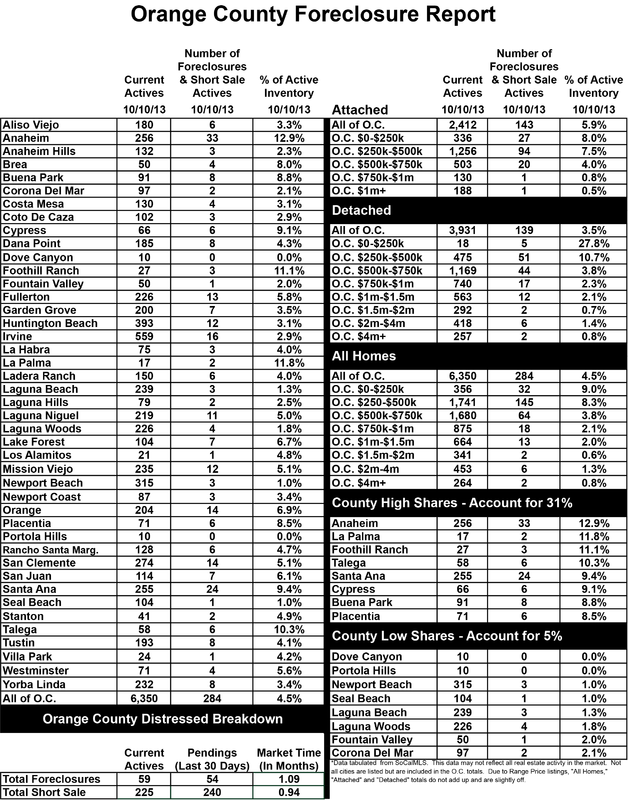
The distressed inventory, foreclosures and short sales combined, increased by 10%, or 26 homes, and now totals 284. Only 4.5% of the active listing inventory and 13% of demand is distressed. Compare that to last year when it represented 13% of the inventory and 36% of demand. Thus, the current market is predominantly homeowners that have equity in their homes and distressed properties have a much smaller role in today’s housing landscape.
In the past two weeks, the foreclosure inventory decreased by 11 homes and now totals 59. Only 1% of the inventory is a foreclosure. The expected market time for foreclosures is 33 days. The short sale inventory increased by 37 homes in the past two weeks, totaling 225, the largest gain thus far this year, beating the prior mark of 25 set just one month ago. The number of currently active short sales has been on the rise, but still remains the hottest segment of the Orange County housing market with an expected market time of only 28 days. Short sales represent just 4% of the total active inventory.