Waiting to purchase a home could be costly for buyers and move-up sellers.
Waiting to Buy: With interest rates poised to increase, waiting is not a good idea. With minimal expected appreciation in 2014 compared to prior years, the sense of urgency to buy is not as prevalent. Instead, many potential buyers are taking their time or putting off purchasing to a later date. This is not necessarily a sound strategy with interest rates forecasted to increase about one-percent compared to where they are today by year’s end.
Interest rates are going up. It is not a matter of “if” interest rates will go up; it is “when” they will go up. They have been held at artificially low levels thanks to the Federal Reserve dumping money into the financial system and keeping the discount rate at an extremely low level for quite some time. The net effect of taking this action for years is increasing pressure for rates to rise. Economically, it is inevitable that interest rates will rise.
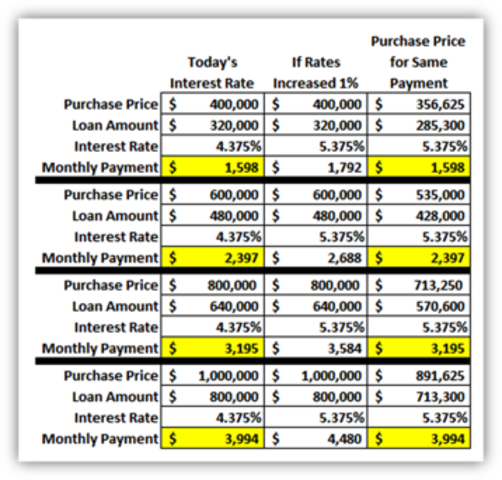
Considering that rates will climb, the impact on monthly payments cannot be ignored. For a buyer that is looking to purchase a $600,000 home with 20% down, the monthly payment would rise by an additional $291 per month with a 1% increase in interest rates. To drive home the point further, if a buyer qualifies for the $2,397 payment, that’s a purchase price of $600,000 today. When interest rates climb by just one-percent, that same payment allows a buyer to purchase a $535,000 home, $65,000 less than today. Rising rates erode purchasing power and affordability drops.
As the price range rises, the difference is even more profound. For a buyer that qualifies for a $3,994 monthly mortgage payment, that’s a purchase price of $1,000,000 today. When interest rates rise by one-percent, a buyer will be looking at an $891,625 home, a difference of nearly $110,000. That is a lot less home.
Home values in Orange County are not going down. Waiting to buy does not make economic sense. Instead, buyers that wait are throwing away hundreds of dollars every single month because rising rates are inevitable. In June of last year, Bernanke and the Federal Reserve announced that they were going to start to reduce the amount of money they dumped into the monetary system every month, also known as tapering. Immediately, interest rates shot up by one-percent. Buyers that did not lock were looking at an instant increase in their monthly payment. These increases are just the beginning. Interest rates prior to the downturn were at 6.4%. They dropped after the Federal Reserve intervened. The Fed is now strategically moving the other direction and interest rates will rise.
For the homeowner who is looking to move up in value, waiting to make the move really does not make any sense at all. Many would like to wait for their homes to appreciate in value before they pull the trigger on selling. Not only are they looking at eroding purchase power with a rise in rates, they are looking to pay more as well. 10% appreciation in a $750,000 home is an additional $75,000. For a $1 million home, it is an additional $100,000. The appreciation rate may be the same, but the net result is additional equity for higher priced homes.
Active Inventory: The inventory increased by 2% in the past two weeks.
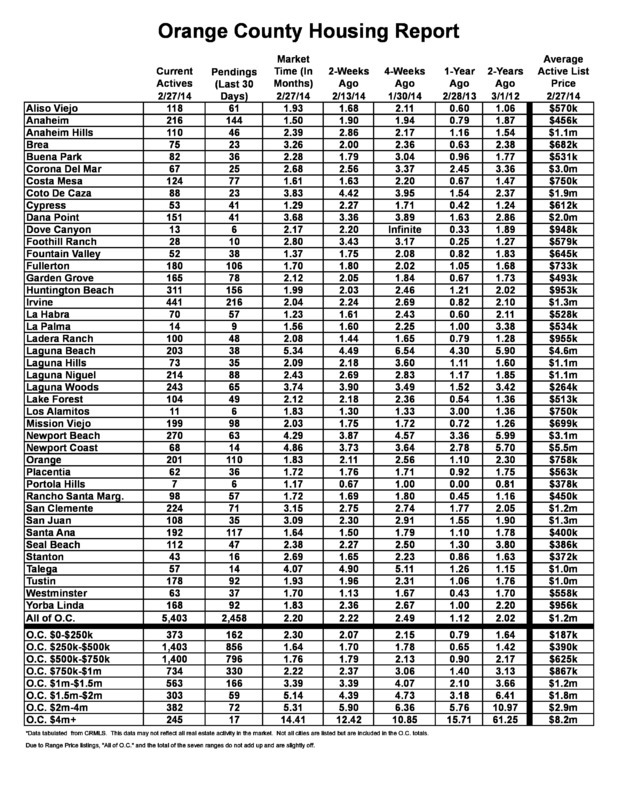
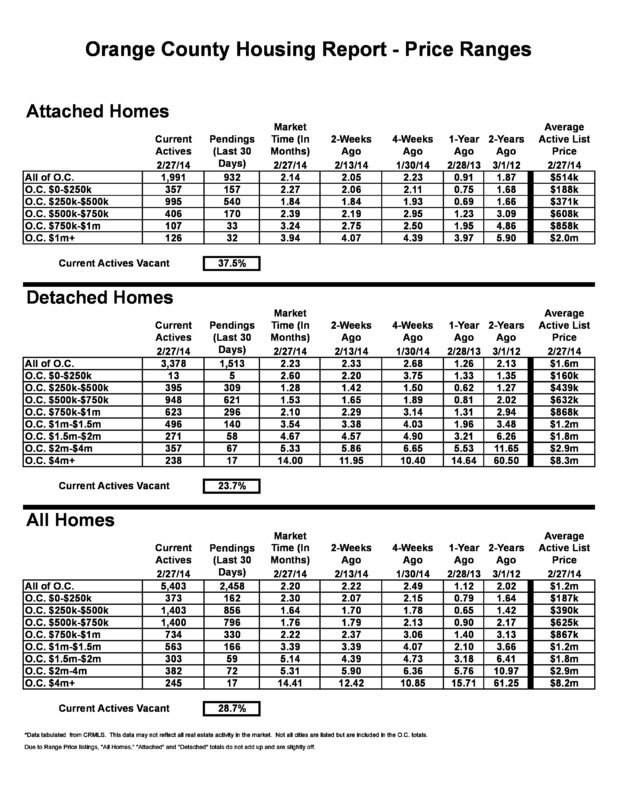
The inventory added an additional 120 homes in the past two weeks and now totals 5,403. Despite the fact that demand is going up, the active inventory continues to climb. More homes are coming on the market than are coming off, thus the rise. Many homes are intially pricing their homes at ridiculously high levels and are sitting on the market. Buyers today want to pay the Fair Market Value for a home and are not willing to overpay for a home.
Last year at this time there were 3,237 homes, 2,166 fewer than today.
Demand: Demand increased by 3% in the past two weeks.
Demand, the number of new pending sales over the past month, increased by 77 and now totals 2,458. Demand will continue to increase and will gain momentum through the Spring Market. Last year demand was at 2,898 pending sales, 440 more than today. Demand may not be at the same clip as last year, but it is growing as spring is right around the corner.
The expected market time for all homes in Orange County is currently at 66 days, dropping from 67 days just two weeks ago.
Distressed Breakdown: The distressed inventory decreased by 13 homes in the past two weeks.
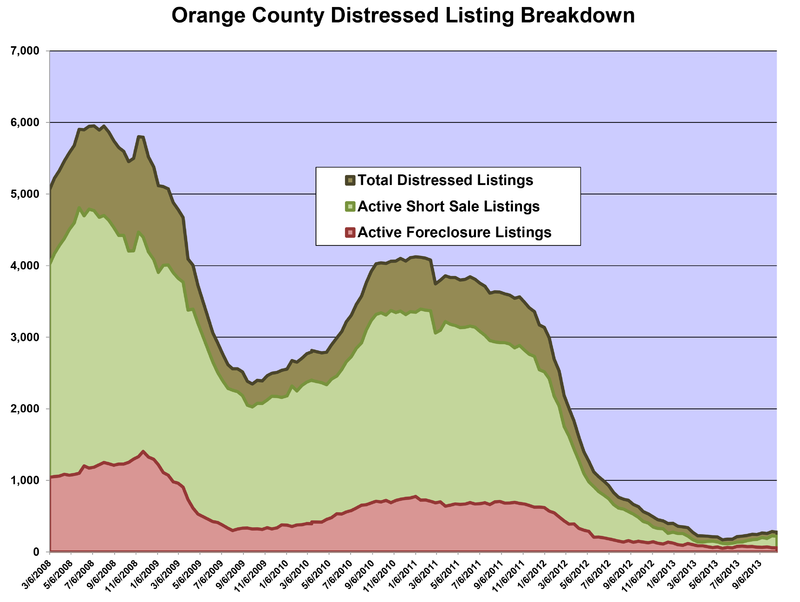
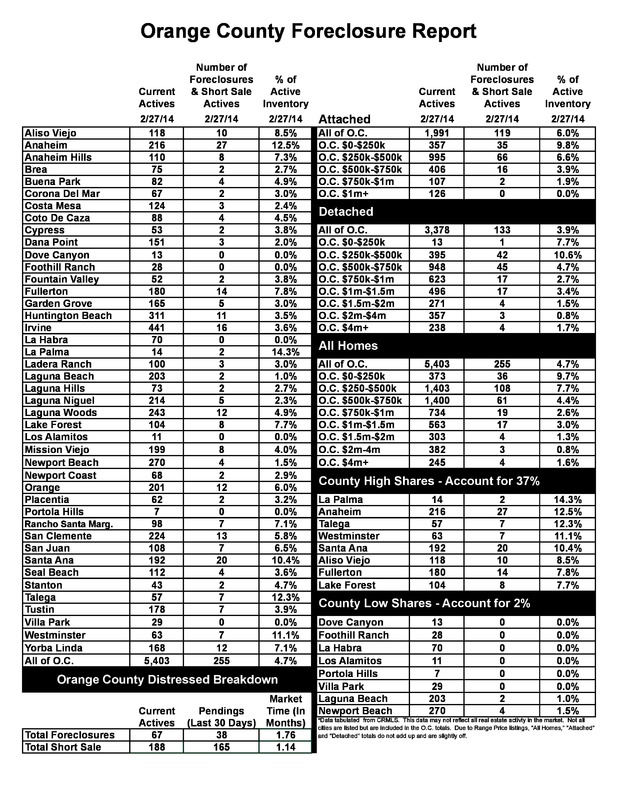
The distressed inventory, foreclosures and short sales combined, decreased by 5%, 13 homes, in the past two weeks and now totals 255. Only 5% of the active listing inventory and 8% of demand is distressed. Compare that to last year when it represented 8% of the inventory and 23% of demand, and two years ago when it represented 30% of the inventory and 52% of demand. Distressed properties have an insignificant effect on the overall housing market because their numbers have dwindled considerably.
In the past two weeks, the foreclosure inventory did not change and remains at only 67. 1% of the inventory is a foreclosure. The expected market time for foreclosures is 53 days. The short sale inventory decreased by 13 homes in the past two weeks and now totals 188. The expected market time is 34 days. Short sales represent just 3% of the total active inventory.
Waiting to purchase a home could be costly for buyers and move-up sellers.
Waiting to Buy: With interest rates poised to increase, waiting is not a good idea.
With minimal expected appreciation in 2014 compared to prior years, the sense of urgency to buy is not as prevalent. Instead, many potential buyers are taking their time or putting off purchasing to a later date. This is not necessarily a sound strategy with interest rates forecasted to increase about one-percent compared to where they are today by year’s end.
Interest rates are going up. It is not a matter of “if” interest rates will go up; it is “when” they will go up. They have been held at artificially low levels thanks to the Federal Reserve dumping money into the financial system and keeping the discount rate at an extremely low level for quite some time. The net effect of taking this action for years is increasing pressure for rates to rise. Economically, it is inevitable that interest rates will rise.
Considering that rates will climb, the impact on monthly payments cannot be ignored. For a buyer that is looking to purchase a $600,000 home with 20% down, the monthly payment would rise by an additional $291 per month with a 1% increase in interest rates. To drive home the point further, if a buyer qualifies for the $2,397 payment, that’s a purchase price of $600,000 today. When interest rates climb by just one-percent, that same payment allows a buyer to purchase a $535,000 home, $65,000 less than today. Rising rates erode purchasing power and affordability drops.
As the price range rises, the difference is even more profound. For a buyer that qualifies for a $3,994 monthly mortgage payment, that’s a purchase price of $1,000,000 today. When interest rates rise by one-percent, a buyer will be looking at an $891,625 home, a difference of nearly $110,000. That is a lot less home.
Home values in Orange County are not going down. Waiting to buy does not make economic sense. Instead, buyers that wait are throwing away hundreds of dollars every single month because rising rates are inevitable. In June of last year, Bernanke and the Federal Reserve announced that they were going to start to reduce the amount of money they dumped into the monetary system every month, also known as tapering. Immediately, interest rates shot up by one-percent. Buyers that did not lock were looking at an instant increase in their monthly payment. These increases are just the beginning. Interest rates prior to the downturn were at 6.4%. They dropped after the Federal Reserve intervened. The Fed is now strategically moving the other direction and interest rates will rise.
For the homeowner who is looking to move up in value, waiting to make the move really does not make any sense at all. Many would like to wait for their homes to appreciate in value before they pull the trigger on selling. Not only are they looking at eroding purchase power with a rise in rates, they are looking to pay more as well. 10% appreciation in a $750,000 home is an additional $75,000. For a $1 million home, it is an additional $100,000. The appreciation rate may be the same, but the net result is additional equity for higher priced homes.
Active Inventory: The inventory increased by 2% in the past two weeks.
The inventory added an additional 120 homes in the past two weeks and now totals 5,403. Despite the fact that demand is going up, the active inventory continues to climb. More homes are coming on the market than are coming off, thus the rise. Many homes are intially pricing their homes at ridiculously high levels and are sitting on the market. Buyers today want to pay the Fair Market Value for a home and are not willing to overpay for a home.
Last year at this time there were 3,237 homes, 2,166 fewer than today.
Demand: Demand increased by 3% in the past two weeks.
Demand, the number of new pending sales over the past month, increased by 77 and now totals 2,458. Demand will continue to increase and will gain momentum through the Spring Market. Last year demand was at 2,898 pending sales, 440 more than today. Demand may not be at the same clip as last year, but it is growing as spring is right around the corner.
The expected market time for all homes in Orange County is currently at 66 days, dropping from 67 days just two weeks ago.
Distressed Breakdown: The distressed inventory decreased by 13 homes in the past two weeks.
The distressed inventory, foreclosures and short sales combined, decreased by 5%, 13 homes, in the past two weeks and now totals 255. Only 5% of the active listing inventory and 8% of demand is distressed. Compare that to last year when it represented 8% of the inventory and 23% of demand, and two years ago when it represented 30% of the inventory and 52% of demand. Distressed properties have an insignificant effect on the overall housing market because their numbers have dwindled considerably.
In the past two weeks, the foreclosure inventory did not change and remains at only 67. 1% of the inventory is a foreclosure. The expected market time for foreclosures is 53 days. The short sale inventory decreased by 13 homes in the past two weeks and now totals 188. The expected market time is 34 days. Short sales represent just 3% of the total active inventory.
:format(webp):quality(80)/u.realgeeks.media/hakolas/Facebook.jpg)
:format(webp):quality(80)/u.realgeeks.media/hakolas/GooglePlus.jpg)
:format(webp):quality(80)/u.realgeeks.media/hakolas/YouTube.jpg)
:format(webp):quality(80)/u.realgeeks.media/hakolas/Twitter.jpg)
:format(webp):quality(80)/u.realgeeks.media/hakolas/Zillow.png)