Orange County Real Estate and Community News

Oct. 2, 2014

Buyers Waiting for Prices to Drop are Silly!

Buyers Waiting for Prices To Drop Are Silly!

Some buyers are holding off purchasing thinking that values will drop, ignoring major market fundamentals.

Timing the Market: For decades buyers have missed golden opportunities to purchase trying to time the market perfectly.

Gone are the days of mass appreciation, multiple offers, and selling prices way above the last sale. 2014 has been markedly different from both 2012 and 2013 when homes flew off the market and values were absolutely soaring. As a result, some buyers are now attempting to time the market, anticipating that prices will reverse course around the corner. They are sitting on the fence waiting for a more advantageous time to purchase. Unfortunately, they are arriving at this decision without all of the facts.

Posted in Buying a Home
Sept. 11, 2014

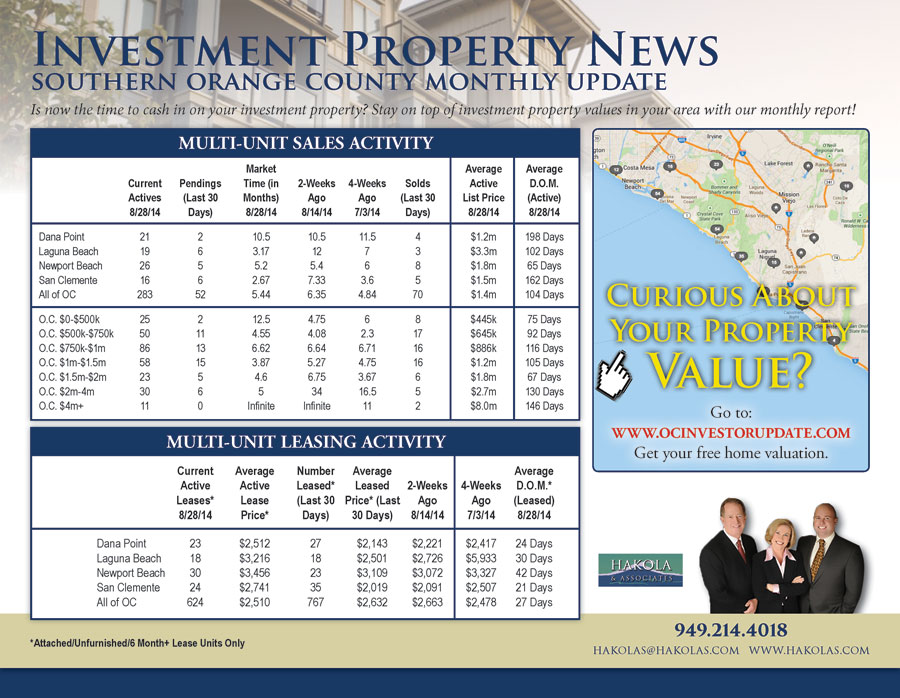
September 2014 Orange County Monthly Investment Property News

Posted in Real Estate News
Sept. 11, 2014

Things To Consider When Contemplating Downsizing

Downsizing your home can be equal parts of a bit scary and a bit exciting. Most people consider downsizing as they are entering a new phase of their lives. Perhaps you sent your last child off to college. Perhaps your children are graduating from college. Or, maybe you’ve finally reached retirement and you want to enjoy yourself and not spend your retirement caring for a large house that you have to repair and keep up.

Whatever your reasons for wanting to downsize, BEFORE you make the decision to do it, here are a few things to consider. By giving the following things careful consideration, you can guarantee that you are going to be happy with your choices.

Does size matter to me?

Whether or not you want to admit it, we all live a little bit of the “keeping up appearances” lifestyle. What would moving to a smaller home do to you, personally? Would you feel like you weren’t progressing to this next stage in life, but rather moving back a step? Would you feel out of place, like you were living below your means?

These are very important things to consider. If you have problems with any of these considerations, downsizing may not be the right choice for you.

Will I miss some important things about a more spacious home?

Sometimes the little things are the important things. For instance, do you currently have your own home office or area where you can work, do hobbies, and/or just relax by yourself and do something leisurely, like read a newspaper?

Downsizing may end up meaning that some of these things that you appreciate and have grown accustomed to have to change a bit. If you are considering moving to an active adult community, law of averages says there is some sort of solution for this problem. If you are simply moving to a smaller house in a different area though, you will need to consider these things, coming up with alternatives for all the things you will miss, to ensure you are happy with your move to a smaller home.

How will other life events affect my living in a smaller home?

Life circumstances should play an important role in considering whether to downsize, or what type of smaller home you might purchase. For instance, entertaining your family. If you are expecting that you will still be doing this, you need to make sure wherever you move can accommodate guests, comfortably.

There are also things you may want to consider that go in the “unplanned” category. For instance, those of you that have just sent your children off to college and/or they just graduated from college. There is a growing trend of children graduating from college, only to return home afterwards. What would you do if this happened?

Downsizing can be a liberating and wonderful thing. It requires careful consideration and planning though, to ensure that you are making the move for the right reasons and moving into something you are going to be happy with, for this exciting next stage of your life.

Sept. 8, 2014

Four Tips To Give Your Home Curb Appeal

Lately, we've been writing a love of articles about the best practices on timing when to sell your home, tips to stage it to make it look it's best, and things to avoid when considering putting your home on the market. There is one thing though that we'd like to share today that is perhaps the MOST important factor to consider when putting your home on the market. Simply put, you need take a look at the curb appeal factor of your home and make sure it's in check, BEFORE you list your home for sale.

Curb appeal is critically important. As they say, "First impressions are everything". When preparing your home for sale, you want to get eveything in line, giving a prospective buyer the maximum opportunity to literally put themselves mentally inside your home, envisioning what it might be like to live in a home like yours, and the lifestyle it would offer. 

If a prospective buyer pulls up to your home and the outside is unkempt and sloppy, it will immediately put them in a bad frame of mind. This will cause them to either skip considering your home all together, or even worse, thinking less of your home and giving you a low offer that you are not expecting. You want to avoid these two scenarios at all costs. To those ends, today we thought we would share with you five easy tips to follow, that will ensure your home has the best curb appeal possible.

1) Get A Power Washer And Use It
Overtime, whether you realize it or not, walkways, driveways, stairs and the eves under the roof of your home will get dirty. This is something that just happens. Just because it happens to everyone's home though does not make this acceptable. Use your power washer to get rid of that layer of dirt, dust and cob webs that have been accumulating over the winter. Pay special attention to any areas that show any sort of staining. It could be something that just needs a little extra attention with the power washer, or could be an early warning of a potentially larger problem that you should have examined by a professional.

2) Make Sure Your Flower Beds Don't Look Like Graveyards
One of the easiest ways to give your home better curb appeal is by simply cleaning all the dead things out of your flower beds. For very little money you can go to a nursery and purchase an array of colorful flowers to plant in place of all the old stuff that will make your front yard look festive, eye catching and vibrant.

While you are stripping away the dead and dormant plants, take a bit extra time to clear out any fallen leaves and branches as well, in preparation for step number 3.

3) Add Mulch or Gorilla Hair To Your Yard Beds
Do you remember when you first put your landscaping in? The mulch throughout your planter beds was fresh, clean and gave the entire yard a sense of newness. Time goes on though, storms happen and "life happens", making keeping this part of your yard fresh and new looking an after thought.

Putting mulch throughout your front yard's planter beds will make it look as if you spent extra time and expense making sure the front yard was just perfect. This will be held positively by prospective buyers, putting them in the psychological mindset from the very beginning that you pay attention to details and keep everything in your house in working order. 

4) Put Color In Pots By The Front Door
Decorative pots by the front door are always a welcoming item to help boost curb appeal. Taking colorful flowering plants and adding them to the pots, in a varying degree of heights and types can make the entrance to your home very inviting. Remember when you do this, you want to keep things symmetrical, so it's pleasing to the eye and not distracting. If you are putting pots on both sides of your front porch and door for instance, make sure that you put the same plants on each side, giving it a clean, even look.

Curb appeal is a critical element to ensuring your home is looked upon in a positive fashion and that prospective buyers not only want to tour your home, but present the best possible purchase offer as well. If you are looking for advice on things you can do to get your home looking the best it possibly can, contact us anytime. We are happy to help you in any way we can.

Posted in Selling Your Home
Sept. 5, 2014

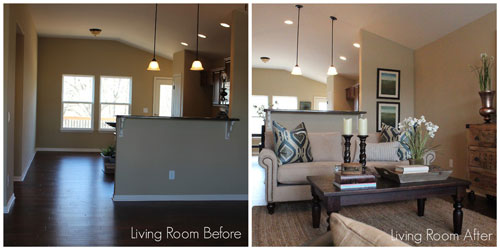
Staging For Dollars - Simple Ways To Make Your On The Market Home Look It's Best

So you are all ready to put your home on the market. You’re excited right? Not so fast! Before you have your Realtor® post your home on the MLS, and before you schedule your first open house, you have to get your home ready for the market.

One of the most important home preparation steps is staging. Staging is difficult, but super important. It has been proven that well staged homes tend to sell for higher prices than homes that aren’t staged. To those ends, today we’d like to share five rules to consider when staging your home, before you put it on the market.

RULE #1: It's not your home anymore
Remember this: You are putting your home on the market. Because of this, you cannot think of it as your home anymore. Look at your home more as a product you are trying to market. You want it to look it’s best and stand out from the other homes on the market. You want prospective buyers to imagine themselves living in your home, and the lifestyle they would have living in the home.

Stage your home in a way that isn’t about what you like, but what would be most appealing to the greatest number of people possible.

Rule #2 Hire a professional. 
The fact of the matter is that staging a home takes lots of time. All told, including planning, picking up needed materials, clearing out and actually staging a home, even a small house can take upwards of 30-40 hours to complete. Then of course there is the expertise factor. Do you “really” know how stage a house so it will look it’s best to prospective buyers?

Given a few phone calls, you will likely find when contemplating doing this yourself, versus hiring a professional, the professional will make the most sense in the long run.

RULE #3- Don’t forget the paint and the windows
It goes without saying that no matter what you do when you stage your home, you HAVE to put a fresh coat of paint on the walls in your home. Fresh paint is not expensive and can really improve the look of your home.

If you have recently painted your walls, just be sure to give them a good cleaning. If you find it is not doing the trick though, do not be afraid to paint.

Along those lines, your windows are super important and something that can be often overlooked by sellers. You want to make sure your windows are clean, and that the window’s treatments you have selected allow for maximum light to come through (especially if you have a small, or dimly lit home).

Buyers are looking for homes that feel open and airy. Using light window treatments will bring in the much-needed light, and actually make your painted walls look even better.

RULE #4 Clutter is your ENEMY
The whole idea of staging your home is to make it look it’s best, when it goes on the market. If you do not get rid of clutter, there is no possible way you can do this. Run through every room in your home and get rid of anything unnecessary or anything that takes up too much space. Things like children’s toy bins, extra appliances on kitchen counters, family photos, or knick knacks from trips.

Also, remember that when touring your home, prospective buyers are going to be looking at “everything”. Make sure cabinets, closets, storage areas, etc. are clean, neat and free of clutter. Storage is a very important thing to a prospective buyer. If your closets and storage areas are cluttered, it will make it look as if there is no storage in your home.

RULE #5 Don’t worry about the whole house. 
Especially if you decided to pay for staging, rather than do it yourself, remember that you don’t need to stage every room. Instead, stage the most important rooms in the house where people will be spending the most time. Again, remember that you want to help prospective buyers imagine what it would be like to live in the home. Focus on the living room, kitchen, dining room and even the master bedroom. If you have left over budget or ideas for any other special rooms in the house, you can always do those as well.

Staging can be a tricky thing. If you want to get the maximum sales price for your home, you cannot ignore it. If you’re getting ready to put your home on the market, and would like some tips and tricks as to what might make your home look it’s best to prospective buyers, contact us anytime. We are more than willing to help in any way we can.

Posted in Selling Your Home
Sept. 5, 2014

Orange County Housing Report: When Pricing, IGNORE Active Listings

Too many sellers fall into the trap of pricing their homes based upon active listings, the wrong approach with so many overpriced homes. 

Pricing Based Upon Active Listings: Sellers pay way too much attention to what other properties are listed at, often a recipe for failure. 

2014 has been the year of the overpriced listing. Price reductions are the new norm. 10% of all active listings reduce their asking prices every week, a trend that has not changed throughout the year. Ask any REALTOR® to search on the Multiple Listing Service and pull up the “1 Line” report and you will see evidence of all of the reductions. Punctuating the list of listed homes are a series of small red arrows pointing down adjacent to their asking prices, indicating that the home has had at least one price reduction. More than half of the homes have the little red arrow prominently displayed. These marks demonstrate that most sellers are pricing their homes out of bounds, outside of their Fair Market Values. 

There are a myriad of contributing factors to so many sellers arriving at these unrealistic, overzealous asking prices: focusing on the desire to net a certain dollar amount; testing the market; leaving negotiating room; expecting massive appreciation similar to 2012 and 2013. Buyers can care less what a seller needs to net from the sale of their home, so sellers unsuccessfully sit on the market until they reduce. Testing the market is a Disneyland Fast Pass to the front of the line to sitting on the market with no success. Adding tens of thousands of dollars to the Fair Market Value to leave room to negotiate is one of the quickest routes to not accomplishing the goal in selling. And, properties are no longer rapidly appreciation like the past couple of years; as a result, pricing in anticipation of rising values is another opportunity to sit until a seller reduces. 

There is another major contributing factor to how so many sellers sit on the market overpriced, pricing their homes based upon active listings. When somebody places their home on the market, 

neighbors eagerly pull a property brochure from the newly stuffed brochure box and quickly search for the list price. They take the flyer home to their spouse as evidence of their own home’s value. What they fail to consider is that it is simply an asking price. In 2014, most asking prices were initially overpriced; yet, neighbors mentally saved the flyers as proof that their home value was continuing to increase. Anywhere from three to six weeks, when a home reduced its asking price, none of the neighbors received an update. It may have taken multiple reductions before a home ultimately achieves success and sold. When neighbors then listed their homes after excitedly viewing the SOLD sign, their expectations of values were all out of whack. 

Today, many overpriced homes never sale. Now that Spring and Summer Markets are behind us, sellers need to choose between becoming realistic, reducing their asking prices, or throwing in the towel, pulling their homes off of the market altogether in anticipation of the slower Autumn and Holiday Markets. When homes are pulled off the market, a memo does not go out to the neighbors explaining that they were unsuccessful in their attempt to sale their home. Neighbors still mistakenly remember the initial asking price from the flyer that they pulled months ago, a price that resulted in sitting on the market without success. 

In meeting with REALTORS® to list their homes, sellers go over all neighborhood active listings and recent pending and closed sales. Many often ignore the reality of pending and closed sales and choose to place way too much weight on active listings. It is quite common today where an entire neighborhood is filled with overpriced listed homes that are just sitting. Even pricing below the lowest priced home may be higher than the pending and closed sales. It too is overpriced and gets to sit on the market like all of the rest of the neighborhood homes until somebody finally decides to take the realistic approach and price based upon the Fair Market Value, correctly ignoring the other active listings. 

In today’s market of very little appreciation, the best approach is to carefully consider the most recent pending and comparable sales and apply very little weight to active listings. Now, if there is an active listing priced below the pending and closed sales, that is a home that must be taken into account. That may be what it takes in some neighborhoods to achieve success. When properties sit for an extended period of time and we move into the slower seasons, some sellers may choose an aggressive approach and price their home for a quick sale. Take note and watch to see if it attracts a lot of attention or attracts multiple offers. These homes can even sell for higher than their asking prices. The bottom line, aggressively priced homes cannot be ignored, as they are paving the way to new trends in an ever-changing housing market. 

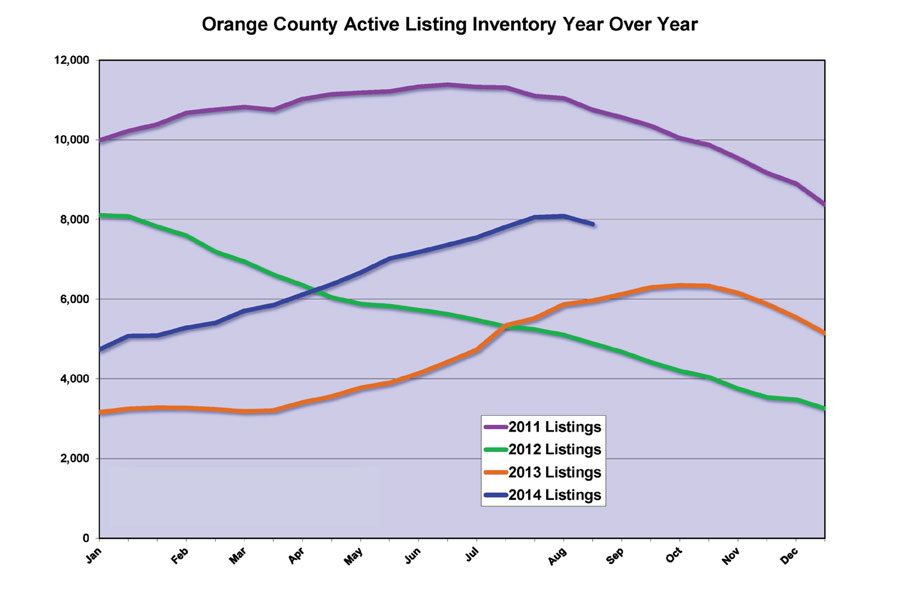
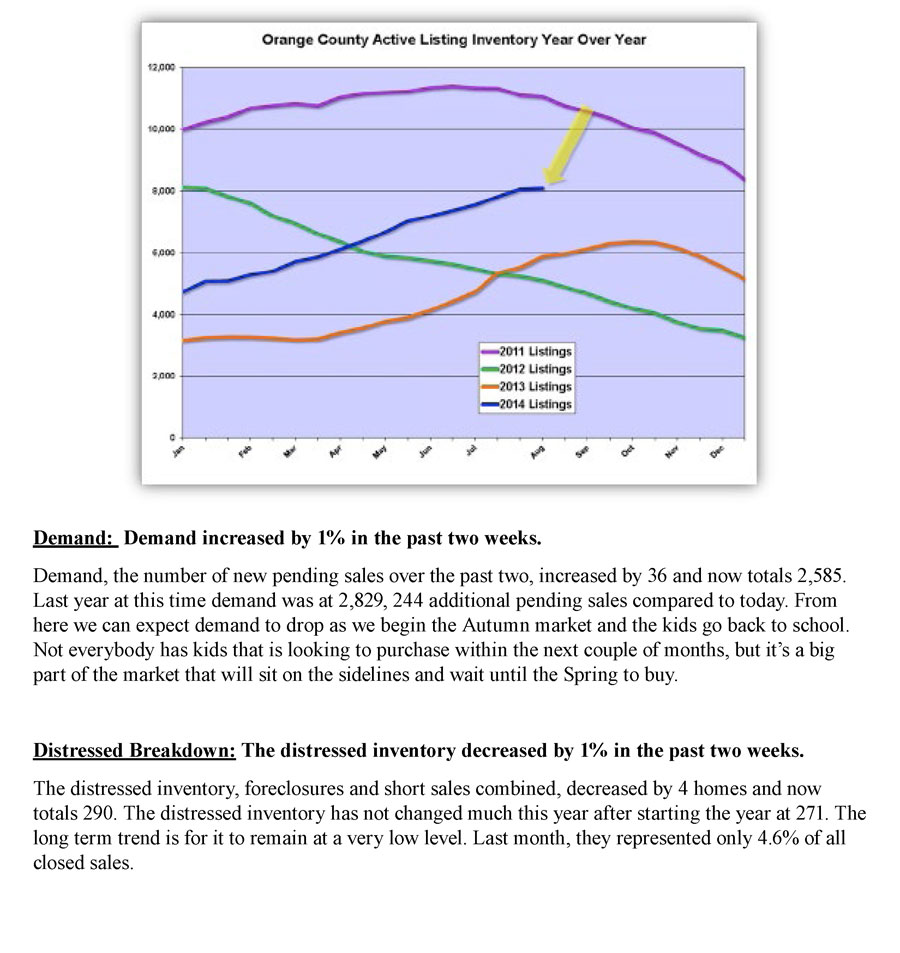
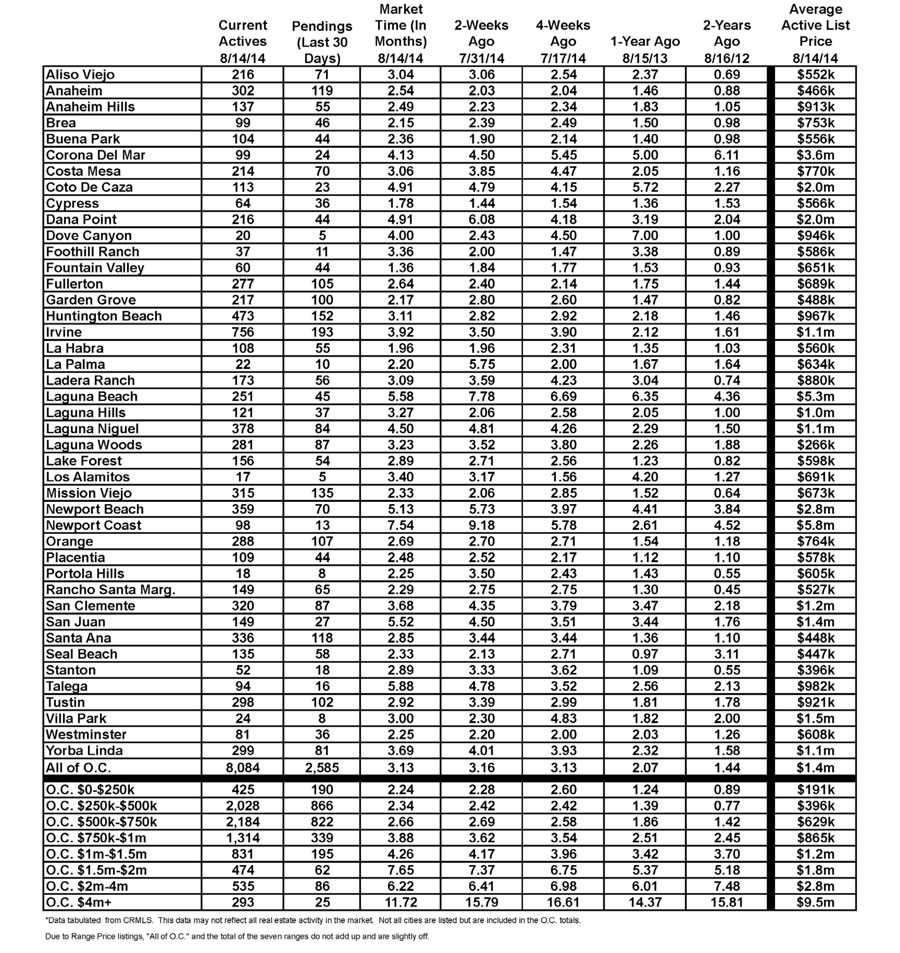
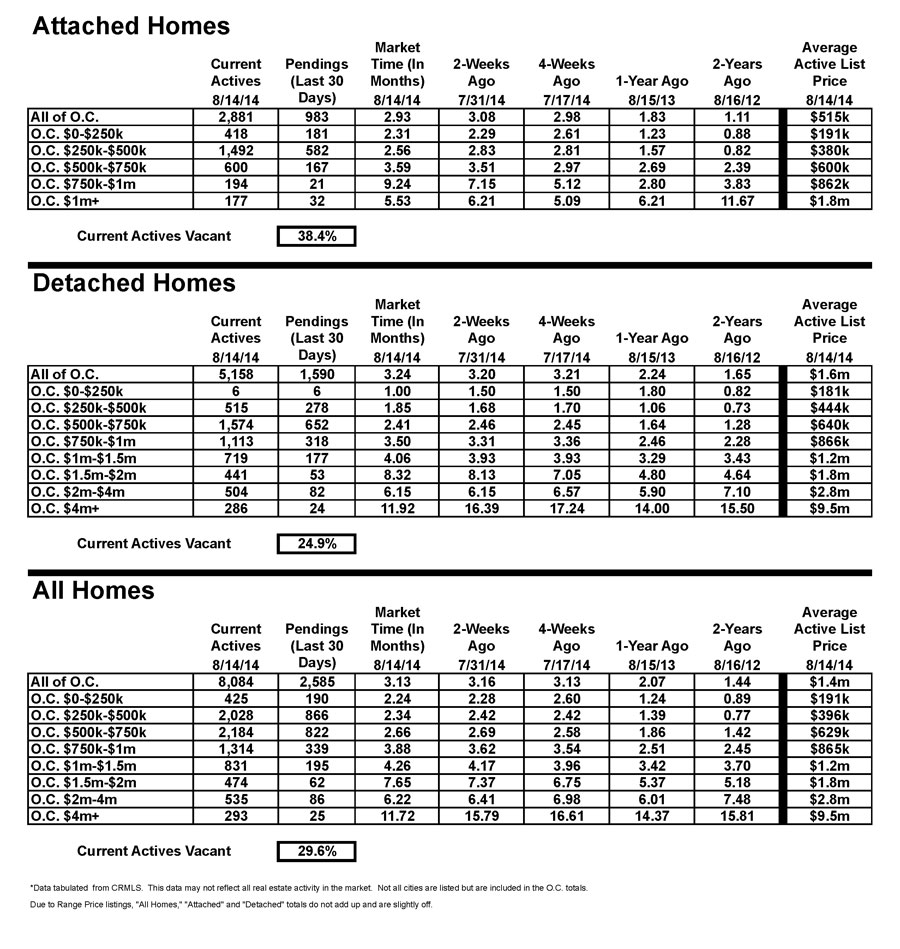
Active Inventory: The active inventory reached the 2014 peak a couple of weeks ago. 

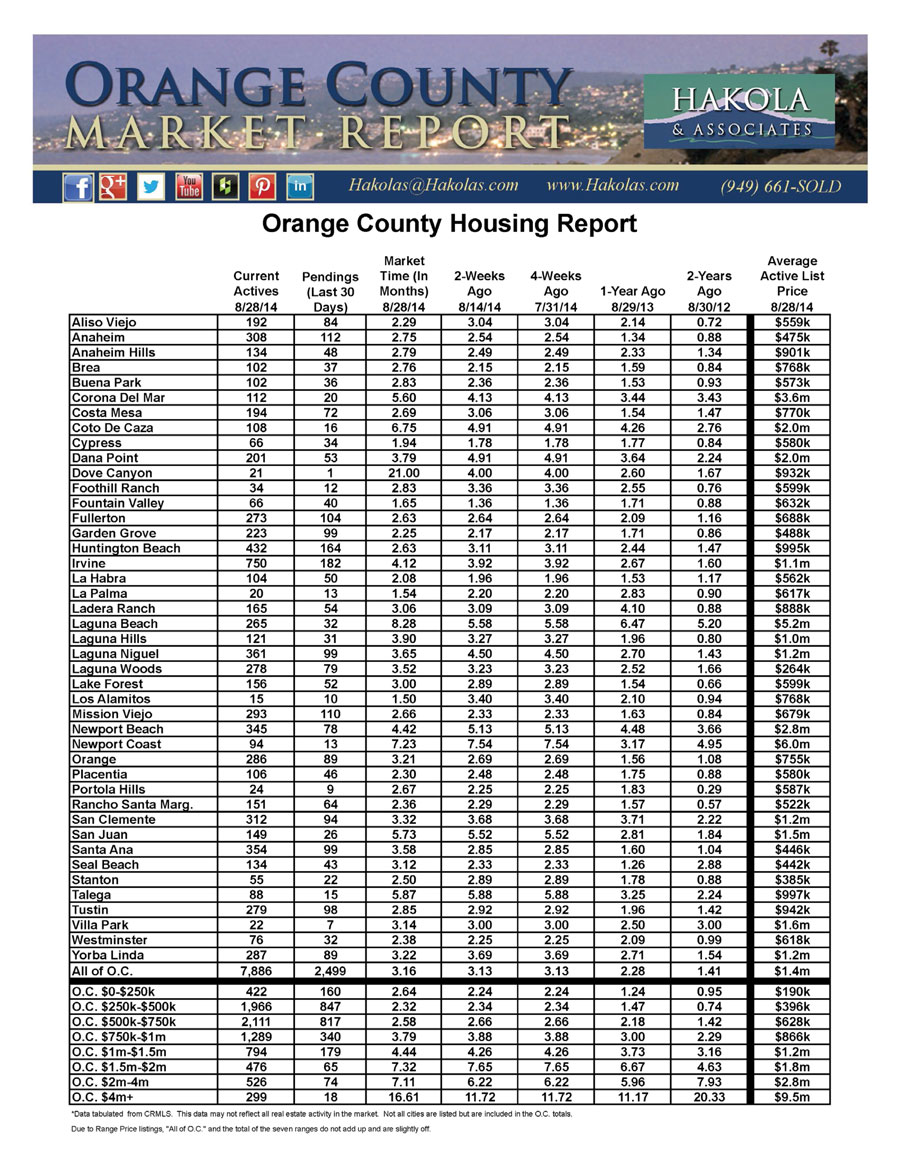
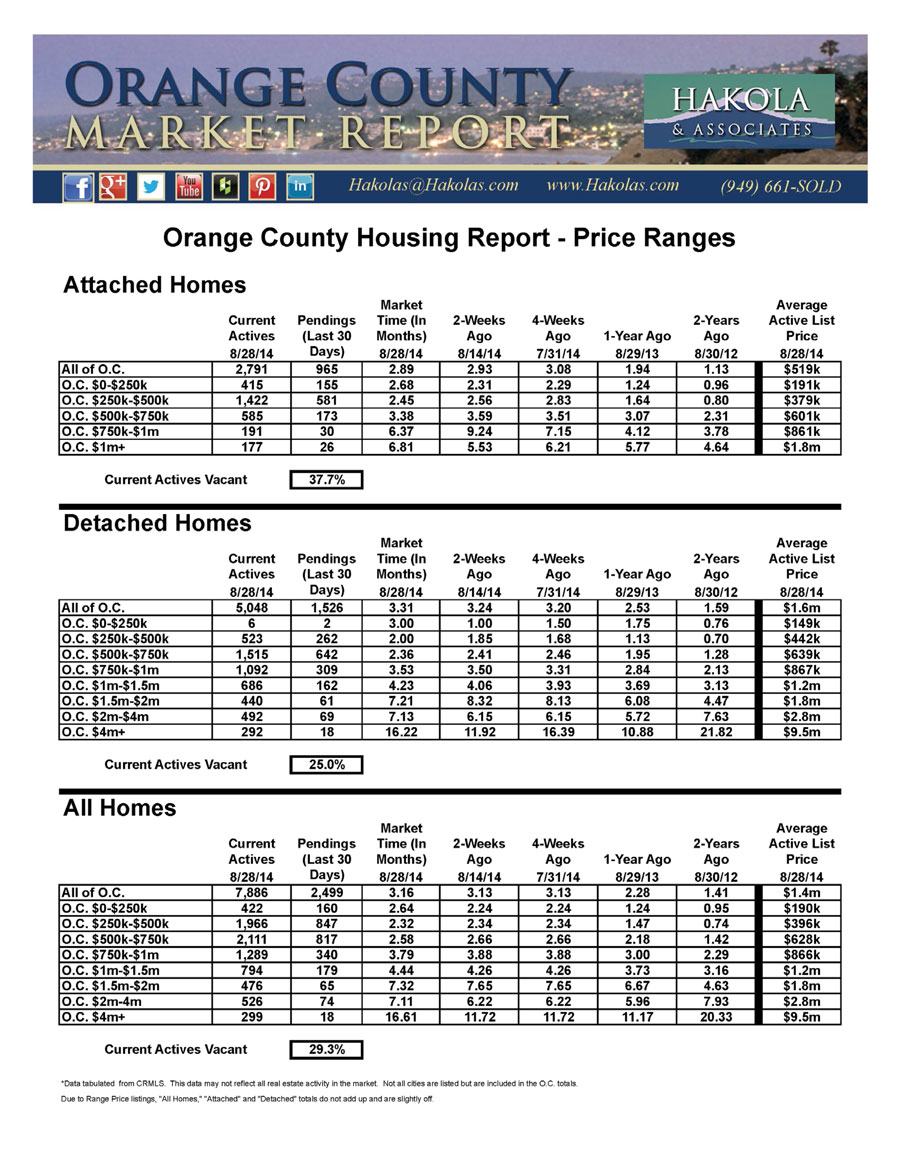
The 2014 active inventory peak of 8,084 homes was reached a couple of weeks ago, part of a normal, housing cycle. In the past two weeks, the inventory shed 198 homes, 2%, and now sits at 7,886 homes. The drop ends the trend of continuous appreciation all year, and is a welcome relief to an 

inventory built on the backs of unrealistic, overpriced sellers. The inventory cyclically peaks towards the end of August, but last year it did not peak until October, an unwelcome sign that sellers were ignoring a simple market fundamental: the Autumn Market downshifts, in terms of demand, from the Summer Market. This year, sellers are quickly coming to the realization that the most active time of the year to sell is behind us, deterring many homeowners from even placing their homes on the market. Many overpriced listings are opting to not reduce their asking prices; instead, they are simply throwing in the towel. 

Last year at this time there were 5,965 homes on the market, 1,921 fewer than today.

Demand: Demand decreased by 3% in the past two weeks. 

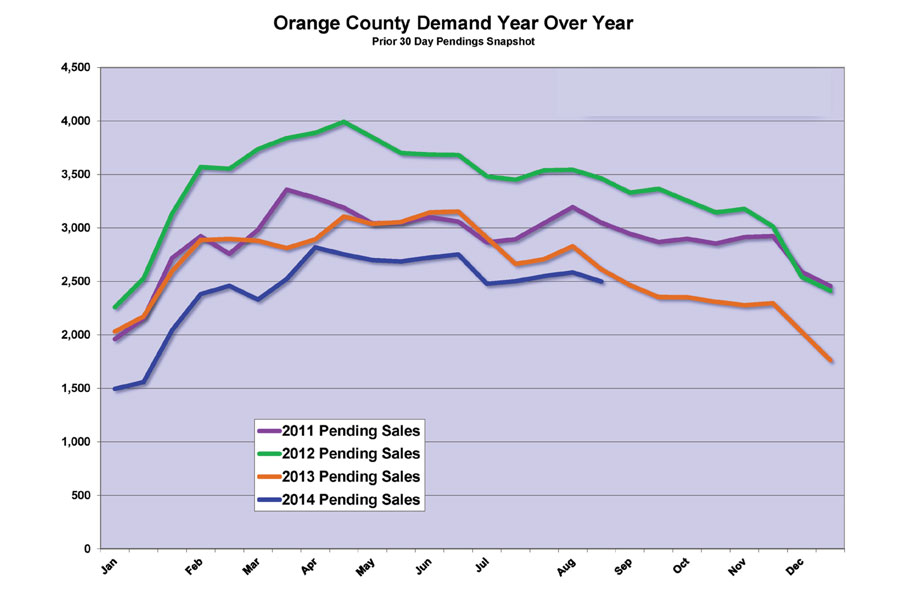
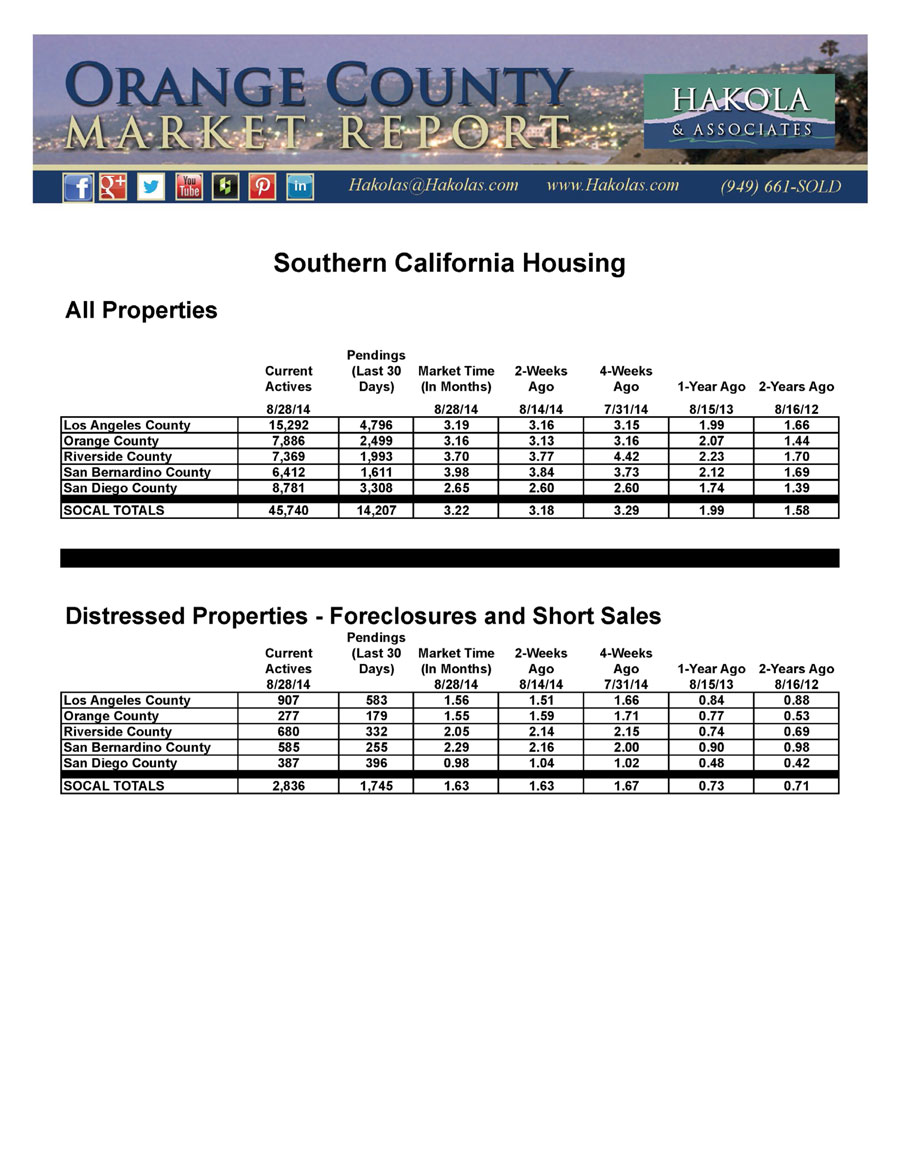
Demand, the number of new pending sales over the past two, decreased by 86 and now totals 2,499, a 3% drop. Over the past 10 years, the average drop at the end of August is 6%, so a 3% drop beats expectations. Last year at this time demand was at 2,613, 114 additional pending sales compared to today. From here we can expect demand to continue to drop a bit as we enter the Autumn Market. With kids back in school, many buyers will wait until next spring to continue their quest for their new home. 

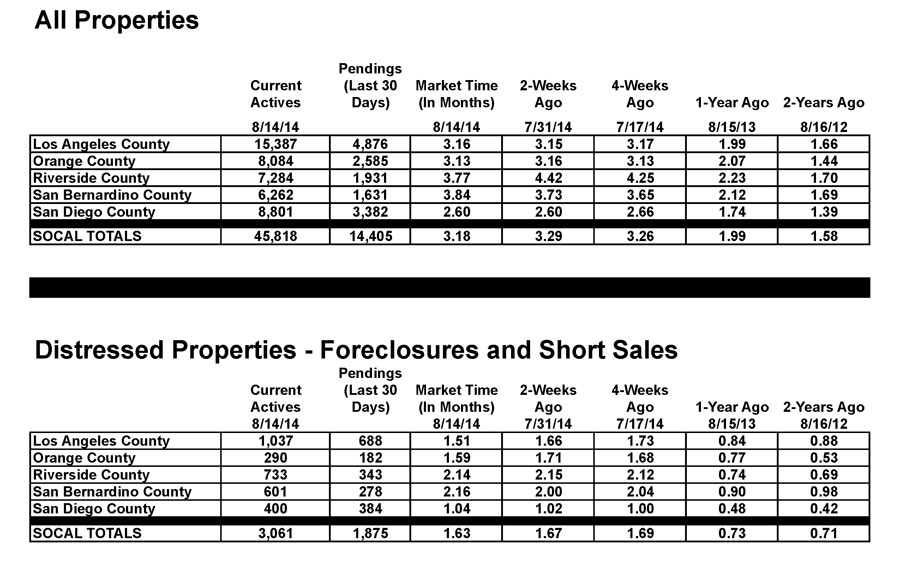
The expected market time for all of Orange County is 3.2 months, or 96 days, a slight seller’s market.

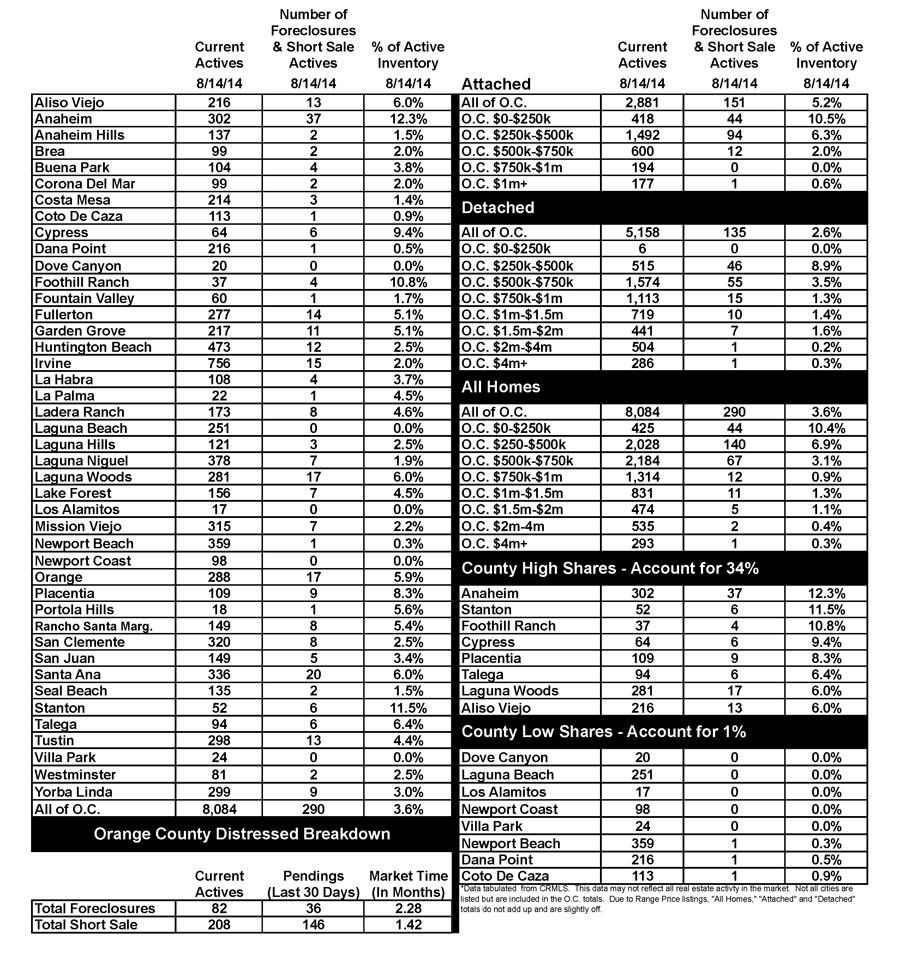
Distressed Breakdown: The distressed inventory decreased by 4% in the past two weeks. 

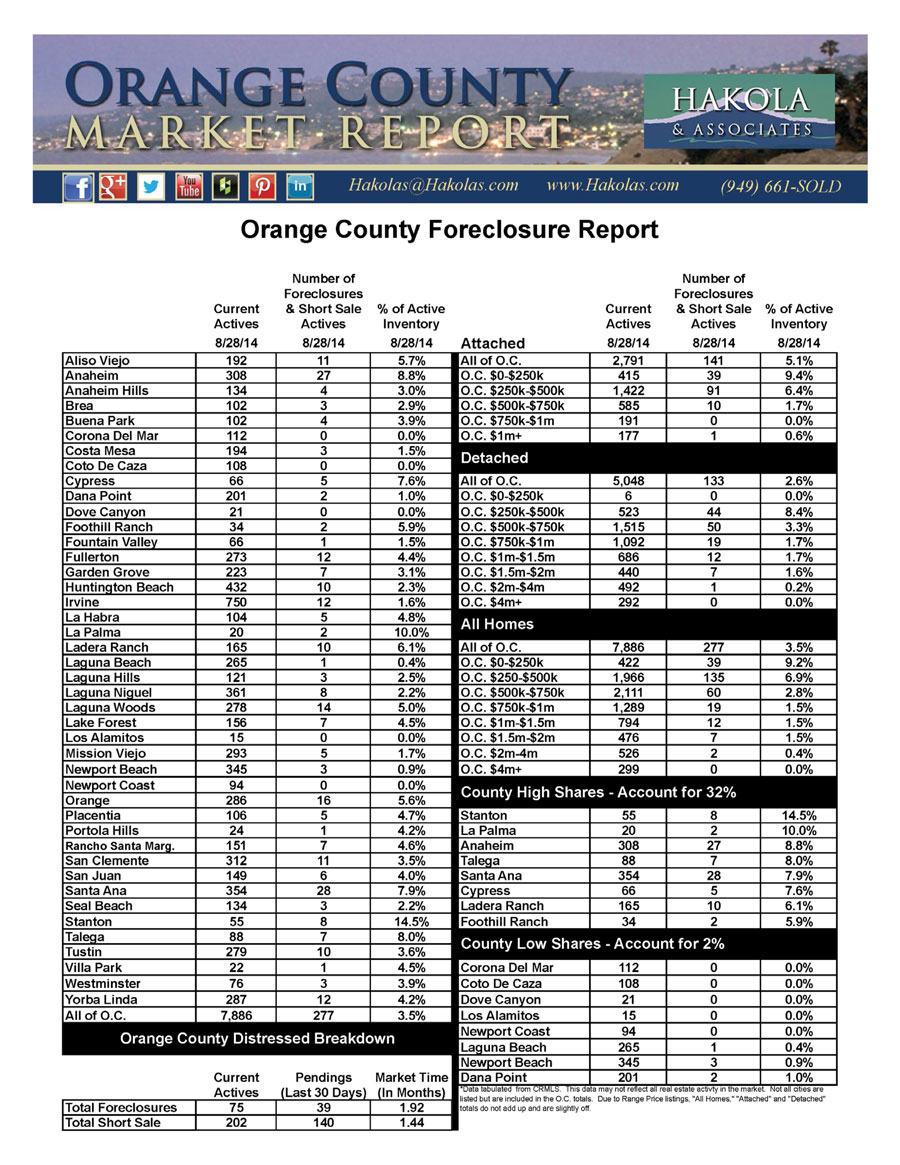
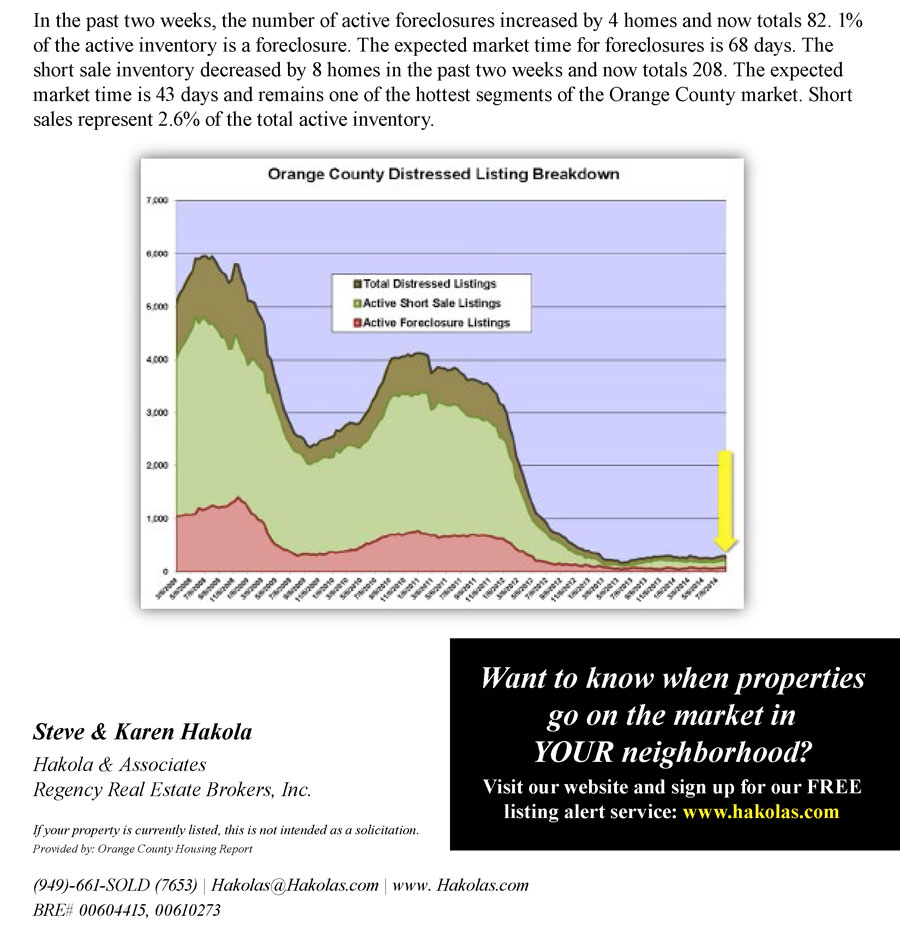
The distressed inventory, foreclosures and short sales combined, decreased by 13 homes, 4%, and now totals 277. The distressed inventory has not changed much this year after starting the year at 271. The long term trend is for it to remain at a very low level. 

In the past two weeks, the number of active foreclosures decreased by 7 homes and now totals 75. 1% of the active inventory is a foreclosure. The expected market time for foreclosures is 58 days. The short sale inventory decreased by 6 homes in the past two weeks and now totals 202. The expected market time is 43 days and remains one of the hottest segments of the Orange County market. Short sales represent 2.6% of the total active inventory.

Posted in Real Estate News
Sept. 4, 2014

Timing The Housing Market - A Layman's Guide

Do you ever wonder how people like Donald Trump make such amazing Real Estate deals? Do they have a crystal ball? Is there a tried and true way to time the market? While even “The Donald” will probably agree that it is actually impossible to time the real estate market, there are some simple techniques you can follow, helping ensure you are most likely to find the sweet spot and profit the most, by “buying low and selling high”

The market is the market, is the market, right?

In reality, the Real Estate market can be a tricky thing. There are many shades in the middle, but at the end of the day, the marketplace you are looking to time will fall into one of three categories:

1) Buyer’s market

2) Seller’s Market

3) Neutral Market

What is a Buyers Market?

Simply put, a buyers market is where there are more available homes for sale than there are buyers looking to buy those homes. As a result, purchase prices on homes in that type of market tend to be lower. Many analysts will suggest that a marketplace is experiencing a buyers market if the total available inventory on the market cannot be depleted in less than six (6) months.

What is a Seller’s Market?

Conversely, when your marketplace is experiencing a sellers market, there are more buyers looking to purchase homes than there are actual homes on the market.

In these types of markets, homes generally experience multiple offers and are sold for over asking price. Additionally, if the market is super tight, you may even see “as –is” sales of homes.

What is a “Neutral Market”?

Lastly, as I am sure you can guess, a neutral market occurs when you have equal numbers of buyers on the market, as homes on the market. Analysts would consider a market a neutral market if the available home inventory is right around 4 months.

Buying in a Buyer's Market

If you are buying a home in a buyers market, you are in the perfect market conditions. There really is no better timing. Now of course if you also have to sell a home to buy a new one, that probably won’t be the case. For those of you though that are in this primo position, you can look forward to taking advantage of these great benefits:

1) Home prices are lower. By definition, there are lots of homes on the market and this means there is risk in listing too high, or not accepting lower offers. If the seller walks away from a potential deal, there is no guarantee that another buyer will come through the door and make an offer.

2) Along those lines, you can also negotiate some of the terms of the purchase to work in your favor as well.

3) If you do need to sell your home, unlike the craziness of a seller’s market, you are more likely to get the seller of the home you put the offer on to accept a contingent sale (meaning your purchase is contingent on you selling your existing home).

Buying in a Seller's Market

Buying in a seller’s market on the other hand is a little more tricky. While it’s not impossible, it is important to consider the following things:

1) You are going to put lots of offers in. Multiple offers on listings and sale prices over asking price are very normal in seller’s markets.

2) You cannot likely negotiate the purchase details with the sellers. They are in the driver’s seat and for the most part, they call the shots.

3) You’re not likely to get a seller to agree to a contingent offer. In that respect, you are better off to sell your home first, try to get a long close and some rent back months, and then look to put offers on homes.

Selling in a Buyer's Market

So what about selling? If a seller does not need to sell, there really is no logical reason to put a home on the market in a buyer's market. Specifically because of:

1) Offers below asking WILL come in. Buyers will feel like you are selling because you have to. Also, if you don’t accept their offer, there are plenty of other homes on the market they can look at.

2) Buyers are going to negotiate the terms of the sale with you. Because of this, you better be ready to give a little, in order to get the deal done.

3) If your home isn’t in perfect working order, you can bet that a buyer is going to require you fix all those little things in the home that aren’t quite right, before they release contingencies.

Selling in a Seller's Market

This obviously is the best possible time to be a home seller. Home sellers have all the advantages in a seller’s market:

1) You can demand higher sale prices. After all, there is no inventory. It’s the whole concept of supply and demand.

2) You don’t have to “play ball” and negotiate on terms with buyers, for the most part.

3) You don’t have to worry about a contingent sale, because if a buyer has to sell their place, you can, with clear conscience, decline their offer, knowing that there are many more coming your way.

When it comes to timing the market, there truly isn’t a crystal ball. Hopefully these tips helped you though and when you do decide to buy or sell, you will be in the optimal position.

 If you have questions, need advice, or just want to get a second opinion, contact us anytime. We’re always here to help.

Sept. 1, 2014

Low Impact Tips On Preparing Your Home For Sale

Tip No. 1 - Make Your Home Look Great

First impressions are everything. Because of this, the way you present your home is critical, in the end, to how easily you will be able to sell your home. Homebuyers are drawn to homes that look spacious and are clean.

When preparing your home to go on the market, your goal should be to de-clutter as much from counters, tables and rooms as possible. Fix up the simple things as well. Squeaky doors, faded paint and even shampooing rugs will make a great difference in the eyes of a prospective buyer. You want your home to smell good and be inviting to potential buyers.

Tip No. 2 - Price Your Home Right

When discussing pricing your home with your Realtor®, even though it is in our nature to want to sell our homes for as much as possible, be careful not to over price your home.

When you over price your home, it reduces the number of prospective buyers that are willing to come see it. On the other hand, if you price it aggressively, it will attract a lot of buyers and in the end, you may very well end up getting the original price you wanted anyways, due to multiple offers and people bidding over asking price.

Another great trick to attracting the most potential buyers possible is to list your home just under the next even number. For instance, instead of listing your home at $1,000,000, consider $999,999. The reason for this is the way homeowners search online. It also plays in to the psychology of how much people are willing to pay for a home, and as a result, what homes they are going to go look at.

Tip No. 3 - Hire a Real Estate Agent

Even though it technically is an expense when selling your home, a qualified Real Estate Professional is CRITICAL to a successful, easy transition from getting your home on the market to selling it and getting the price you want.

Realtors® have access to things you’ll need, such as contractors, photographers, marketing teams, etc. They will supply you with everything you need and the correct advice to help you get your home ready for the market, in the shortest, most efficient manner possible.

 
As with all things, along with tips to make things easy to get your home on the market, there are a few things that you want to be sure to avoid as well:

Mistake No.1 - Getting Emotionally Involved
Once you decide to sell your home, you need to start thinking of things in a much more utilitarian mindset, versus what you personally like. Put yourself in the heads of prospective buyers and give thought to what improvements, types of staging and clean up would appeal to the largest number of people.

Remember, you are inviting people to come in and look at your home, so they can get in the mindset of what it would be like and what kind of lifestyle they would have if they owned your home. Imposing your personal preferences in the things you do while preparing your home for market will make it hard from prospective buyers to get in this mindset. Staying detached emotionally keeps it about the home, and not what your personal preferences are.

 Mistake No.2 - Skimping on Listing Photos

The fact of the matter is that virtually EVERY buyer today starts their home search online. If you a trying to cut expenses and are considering cutting out the professional photographer, think again. Your photos need to be crisp and clear, making prospective buyers stop and look at the online listing, and in the end making them pick up the phone and call their Realtor® to schedule a showing of your home.

Mistake No.3 - Not Being Properly Insured
It may sound silly, but there are going to be many people visiting your home. While it may be slim, there is always a chance that somebody will injure themselves while on your property. As a result, review your insurance policies to make sure that you are covered if such an event occurs. Additionally, think of your home in terms of safety. If you see a potential hazard, take steps to alleviate it.

You can always find comfort in being, “better safe than sorry”.

Mistake No.4 - Trying to Hide Significant Problems
Even though the title of this article is “Low Impact Ways To Prepare Your Home For Market”, low impact doesn’t mean simply hiding problems to avoid dealing with them.

Rule of thumb: A significant problem you have hidden WILL BE FOUND during the home inspections.

Do not make life any harder on you than it needs to be. With significant problems, you have two basic choices. You can either fix the issue, or price your home appropriately, given that the problem is going to have to be addressed by the new buyer.


Putting your home on the market does not have to be a stressful experience. Our team has helped hundreds and hundreds of homeowners get their homes on the market easily and sell them for top dollar. If you would like to discuss your needs, or simply have a few questions and would like some impartial advice, contact us anytime.

Posted in Selling Your Home
Aug. 21, 2014

Foolish Things Buyers and Sellers Say

Buyers and sellers have been known to have unrealistic expectations in approaching the housing market and they say the funniest things. 

Foolish Talk: Buyers and sellers who buy into some foolish thinking will not find success in today’s Orange County real estate market. 

Real estate professionals from all corners of Orange County have provided plenty of feedback as to what buyers and sellers have been saying as they approach the 2014 housing market. If you have not been paying close attention, this year has been plagued by the overpriced seller and the jittery home buyer. Here’s a short list of the top foolish things that buyers and sellers are saying today: 

SELLER: “We need to net $XX,XXX from our home.” There is not a single buyer who cares to know what a seller wants to net from the sale of their home. Buyers are not asking their REALTORS®, “How much do the sellers need to walk away with from the sale in order to be satisfied?” On the contrary, buyers are doing their homework and pouring over comparable sales to arrive at a fair price. A smarter approach for sellers is to look at the true fair market value for their home and determine the net proceeds based upon that value. If a seller determines it is not enough, they should NOT sell their home. This is not a market for testing the water; instead, they will be just wasting their time. Pricing a home based upon the fair market value is crucial to be successful today. 

BUYER: “Everybody has been wrong about interest rates and they are not going to rise.” Interest rates have remained low throughout 2014 and are not expected to rise in the short term. Despite so many housing experts forecasting higher interest rates, it has yet to materialize. As a result, buyers feel that since the experts have been wrong over and over again in regards to rates, then they will remain low for a very long time. However, interest rates have to rise for simple fundamental economic reasons. There’s a 100% chance that they will rise. The government has dumped so much money into the U.S. monetary system to jump start the economy and housing, basically printing money, that eventually rates will rise as inflationary pressures build. Raising interest rates is the main way to fight inflation. It is not a matter of “if” rates will increase; it is “when”. When will that happen? Nobody knows. But, waiting until that occurs is a foolish proposition; instead, buyers should take advantage of these historically low rates. In 5 years from now, they will look back and know that buying while rates were low was nothing short of genius. Prior to the downturn, interest rates were above 6%. Since then they have been artificially reduced through the actions of the Federal Reserve. When rates increase from 4.125%, where they are today, to the level prior to the downturn, buyers will be looking at paying an extra $700 per month for the median sales price. 

• SELLER: “We need to leave a little extra room for negotiations.” Why in the world are sellers leaving room for negotiations? In adopting this strategy, sellers are overpricing their homes and wasting valuable market time. Overpriced listings don’t sell today. These homes sit on the market and miss the opportunity to cash in on the first few weeks of selling. That’s when a new listing obtains the most showings and most exposure. Today, buyers are very sensitive to price and they do not want to overpay. The best approach for sellers is to price according to the fair market value and hold firm to that value. 

• BUYER: “We are nervous about buying right now and it could be a buyer’s market soon.” With an expected market time of just over 3 months, the current market is not even close to a buyer’s market. This is more wishful thinking on behalf of buyers and is unsupported by the facts and housing data. 2014 is very different from 2012 and 2013 when homes were flying off the market at just about any price. Just because prices are not skyrocketing out of control does not mean that the market has shifted to a buyer’s market. However, the market is moving more towards a normal, balanced market where neither buyers nor sellers will be able to call the shots. Today, it is a seller’s market with very little appreciation. That means that homes will sell close to the most recent comparable closed sales and sellers will be able to control the terms. 

• SELLER: “We feel like we left money on the table and could have got more.” This is crazy talk! Sellers are coming to this conclusion because they actually have to negotiate today. They are recalling the last two years when they heard how homes were flying off the market in just days and sellers were obtaining prices above their asking price. While a seller negotiates with a buyer, they should keep in mind what homes were selling for one or two years ago. Yes, they were selling like hotcakes, but they were selling for far less. Instead, sellers should be counting their blessings at the values that they are able to obtain, the highest in seven years.

SELLER: “We are going to wait until the Spring to sell.” Just about everybody is fooled into thinking that they need to sell in the Spring in order to secure a higher sales price. That logic means that sellers will be selling at a discount during the Autumn and Holiday Markets. Sellers are not even remotely thinking about discounting their homes in the coming months. Many sellers will be throwing in the towel with both the Spring and Summer Markets in the rearview mirror. Activity will slow, but so will the number of sellers that remain on the market. There won’t be as much new competition either. On the contrary, during the Spring Market their will be a lot more new sellers entering the fray, just as there will be more buyers looking to buy. A few years ago, I tried to show with numbers that the Spring Market was the best time of the year to sell, but the data just did not support the hypotheses. Instead, there seems to be a balance. When there are fewer homes coming on the market, there are fewer buyers as well. When there are more sellers, there are a lot more buyers. The bottom line: homes are not appreciating right now, so waiting until the spring will prove to be fruitless.

Active Inventory: The active inventory increased is reaching its 2014 peak. 

The active listing inventory added an additional 27 homes in the past two weeks and now totals 8,084. That’s the smallest gain in the inventory since January. It appears that the inventory will peak by the end of this month, following a normal housing cycle. As summer comes to an end, more and more sellers will opt to throw in the towel knowing that the most active time of the year to sell will be behind us. As a result, the active inventory will start to fall during the Autumn Market. 

Last year at this time there were 5,869 homes on the market, 2,215 fewer than today.

Posted in Real Estate News
Aug. 20, 2014

JUST LISTED! 228 Avenida Majorca #C - Laguna Woods

Fully furnished and recently upgraded and tastefully decorated “New Seville” floorplan (bedrooms on each level) offers a quiet and peaceful location offering 2 bedrooms, 2 baths and a fully enclosed atrium type patio. New paint, carpets, luxury vinyl wood look floors, appliances, remodeled baths, 3 separate A/C heating units, ceiling fans, shutters, wood blinds, mirrored wardrobes, 5 flat panel TVs and much more.

Enjoy direct access to your fully enclosed atrium style patio. Close proximity to community laundry facilities and bus stops. This Senior Community requires one person to be 55+ to reside in the community. Investors can purchase but must rent to a 55+ Senior.

Laguna Woods is an active adult community offering 8 clubhouses, 5 pools, tennis courts, 27 hole professional gold course, driving range, fitness centers and over 250 clubs and social activities. For 50 years, Laguna Woods Village has been the premier Southern California community for independent, resort – style living for people 55 and older. Just ten minutes from the Laguna Beach coastline, Laguna Woods Village is located on 3.8 square miles of rolling hillsides in South Orange County, California.

List Price: $279,900 

Posted in Buying a Home